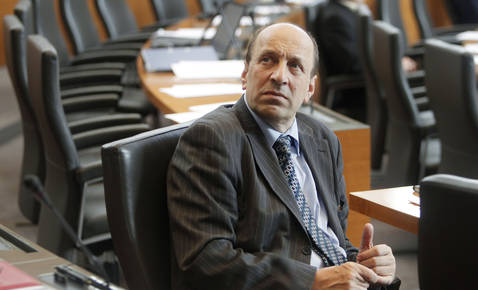
Vexating Veber

Defence minister Janko Veber landed in a massive pool of boiling water. Last week the parliamentary intelligence oversight committee made a surprise inspection of the OVS, the military intelligence service. The inspection uncovered that the OVS, acting on Veber’s orders, was making inquires about the sale of Telekom Slovenije, the state-owned telco which is in the final stages of privatisation of its large part. Since Veber, a senior official of the coalition SocDems has a bit of a history of loudness regarding the sale (before being appointed minister he decried the intended sale as high treason) and since the SD as such is less than lukewarm on privatisation of the company, all hell broke loose. The SDS and the NSi, the latter in the form of its young-and-stellar MP Matej Tonin were quick to claim Veber was abusing office and using the intelligence service to derail the already protracted sale. And to be honest, Veber didn’t do a particularly good job at proving them wrong.

20150323_veber
Defence minister Janko Veber is in the spotlight these past couple of days (source)

The whole thing has a couple of dimensions. First, there’s the fact that Veber did a shitty job at explaining himself. He first claimed to have been within his rights and indeed duties and that he only asked the OVS to check the effects of selling Telekom on critical military, intelligence and first-response systems under the assumption that threat prevention would be harder if Telekom was foreign-owned. Which of course begs the question just how easy is Telekom making it for intelligence services to wire-tap, collect and retain data while it is state-owned. To put in other words: could be be that in a post-Snowden world a privatised Telekom Slovenia would actually be good thing from the standpoint of an average Slovenian‘s privacy?

Because based on a report initially released by the ministry of defence after the story broke, the analysis showed that most of Slovenian first responders, civil defence and natural disaster management services use Telekom infrastructure and commercial services and that quality of those would diminish if the company would become foreign, possibly German-owned. However, the report has a couple of problems. It’s not really an analysis but rather an amalgam of second-hand reports, mostly from Croatia, where Deutche Telekom snapped up their state-owned telco and statements that existing quality of service needs to be maintained even after the sale is completed. While legitimate concerns, these aren’t exactly rocket science and you don’t really need military intelligence service to come up with a two-page report.

And secondly, the report pre-dates Veber’s order to OVS upon which the parliamentary committee “stumbled”. At that point calls for Veber’s resignation were mounting and despite his initial defiance he soon realised that his was a precarious position as PM Cerar did not exactly run to support him. As a result and at insistence of the NSi the defence minister admitted to existence of a second, more detailed report which he even declassified although it is still a working paper, not a final document. This report shows various sections of the OVS have a different take on the effects of the sale. The predominant view seems to be that the ownership of the company does not matter and that there are no reports on potentially harmful effects of the sale, but the OVS did not yet make a final conclusion.

This report has a problem, too. And that is that Veber, although he claims all along that he was only acting in the interests of national security, declassified a working paper which pointed out a division within the OVS and did so without batting an eyelid the moment his political survival was at stake. This, of course, gives some credence to claims by Tonin that Veber was following a political rather than a national-security agenda when he issued the order.

But then again, the parliamentary intelligence committee, too, didn’t just stumble upon the relevant documents. The inspection party, which besides Tonin included MPs Branko Grims of the SDS and Matjaž Nemec of the SD, knew exactly what it was looking for. At the very least, Tonin and Grims did. Tonin later claimed they were pointed in that direction by an OVS whistleblower. But for a person to become a whistleblower, he or she must go public with the information if not reveal his/her identity. What Grims and Tonin came up with was an inside leak by an informant within the secret service. Which smacks of precisely the same abuse of intelligence service they are accusing Veber of.

So what we are looking at, in fact, is amateur night of attempts to make political gains over sale of Telekom, market value of the company be damned. The MPs obviously knew what they were after, which makes this a political raid rather than a proper parliamentary inspection. And yet, at the same time Veber is stumbling over his own legs trying to come up with some sort of plausible explanation for his misconduct. Because misconduct this was.

The last, and most worrying dimension of the whole issue is the fact that Veber ordered military intelligence to poke around a civilian issue. This country was built on re-establishing civilian control over the military and anything that smacks of things being the other way around. OVS is not the only government service to use Telekom infrastructure. It is also not the only one to wire-tap its cables. In fact, SOVA and possibly the CrimPolice are the only government inteligence agencies that can legally and legitimately make inquires into deals about Telekom. Even more, they can do so in behalf of the OVS as well, leaving the military spy-service well out of it.

This appears to have dawned on the SD as well. Namely, earlier today Siol.net (ironically, a news portal in part owned by Telekom) reported that the freshly minted party gen-sec Dejan Levanič threatened the party will quit the coalition should PM Cerar demand Veber’s resignation. But Levanič later claimed he was misunderstood while party boss Dejan Židan said Veber’s dismissal was only a hypothetical posibility and reiterated Veber was victim of a smear campaign.

Perhaps. But the fact remains that he asked a part of the military to busy itself with a civilian matter. And he is doing a very poor job of explaining himself. If this drags on much longer, the OVS report might become less of a problem than a defence minister who is turning into damaged goods.


Fee Fight, A Gift That Will Keep On Giving

While the rest of the EU is musing over the antics of the Slovenian CrimPolice who are flashing search warrants left and right investigating the brouhaha regarding former PM Alenka Bratušek’s bid for the EU Commissioner post, her succerssor Miro Cerar is suddenly faced with a problem of a different and potentially much more disastrous kind. Namely, he may be facing calls for his resignation over the extra pay he earned as a consultant and/or researcher in addition to his tenure at the Faculty of Law.

20150313_blog
Both PM Cerar and FinMin Mramor made The List (source)

The whole thing exploded late last week when the ill-fated anti-graft commission released a report stating that over the past decade or so, about a billion and a half euros in additional earnings were paid mostly (but not exclusively) to high-profile university professors including minister for higher education and science Stanka Setnikar Cankar who apparently earned 600k euros on research projects. Now, 600k over eleven or so ain’t exactly peanuts. 50k per annum in Slovenian terms means doubling an already very hefty paycheck. On the other hand, research projects are where scientists and lecturers put their expertise to (good?) use and make money.

The report was a bombshell, both because the name that appeared on it and included Prime Minister Miro Cerar and financial minister Dušan Mramor and because the amounts in question were within the scope of imagination of the average Slovenian. You see, 600k euros is indeed a lot of money, but it is not an amount of galactic proportions where one would not now what to do with all that cash. Difference between 10 and 20 million? In the mind of the ordinary taxpayer almost negligible because they a) will never see that kind o money and b) would never know how to use it if they did. But 600 big ones? That could buy the house they always wanted, plus the unnecessarily oversized car and a vacation in South-East Asia. It’s the same thing that got Janša. Do millions of euros-worth of arms deals and no one cares. Fail to explain an apartment’s-worht amount of money, people will take to the streets.

So when Setnikar Cankar emerged as one of the top earners, a short but intensive barrage commenced at the end of which she offered to resign. Apparently the accepted wisdom was that due to her hefty additional income in the last decade she has no moral or political clout to negotiate changes to education system. Which poses an interesting question: are the only people acceptable to hold public office those who are unable or do not want to use resources at their disposal. Because save an apparent conflict of interests, Setnikar Cankar broke no law. Sure, it looks unhealthy (and it probably is) but odds are that the whole thing isn’t illegal. So that was mistake numero uno.

Mistake numero due was committed by Cerar who accepted the resignation. This was plainly wrong for a couple of reasons: first and foremost, he just let go a minister from his party’s quota. This suggests that a) he believes there many people who would be willing to take up the job (tehre aren’t) and b) that SMC’s vetting process still sucks donkey balls. This alone would be embarrassment enough by the PM but he exabberated it further when he indeed let Setnikar Cankar go, because he opened a direct route for attacks on himself as he is on that infamous list, too.

And sure enough, the political body of Setnikar Cankar had not even cooled off when Cerar, too, was faced with calls to resign and to take finance minister Mramor with him, forcing him to hold a press conference to respond to the allegations. He said that everything was a-ok, that he earned the extra 350 grand fair and square, ditto finance minister Mramor and that we should all just chill.

Which is a fair point. These high earners, despite their admittedly high cumulative incomes, were in fact applying years if not decades of experience. As Boštjan Narat succinctly put it in his blogpost on the issue (Slovenian only), one should be able to charge for that. Whether or not they were making research projects their private little gardens to cultivate and grow euros is, of course another matter. But this particular angle was hardly addressed. As was the question just how tangible (if at all) were results of their research. Because the issue here is – how very Slovenian – the fact these people earned money beyond their salary. Because Bob forbid you should be doing stuff on the side, let alone pay taxes from it.

But the political take-away here is entirely different. What we have here is a Prime Minister’s blunder of epic proportions which will turn a non-issue into a gift that will keep on giving.

You see, Cerar axed Setnikar Cankar within 48 hours of the story breaking. Probably in the name of political expediency, hoping the issue will go away. But they never do, do they? Thus in effect what PM Cerar had done was

a) accept the issue as a legitimate one (which it needn’t be), thus
b) admitting there was a sense of urgency to is and
c) letting the situation to spiral out of control.

As a result, the issue is no longer a semi-important minister with a semi-important portfolio (gone are the days of then minister Gregor Golobič threatening coalition rift to get additional budget funding for technology and research), but the fate of the prime minister himself.

Sure, Cerar tried to impress on the media that his case was different, but in the end, no one really cared. Why should they? If a portfolio minister is axed because of excess earnings while she was not holding public office, why should the PM be treated any softer? Indeed, going on past experience, the PM is held to an even closer scrutiny, justified or not, than his ministers.

This will not blow over easily. Slovenian public and indeed the media are much more comfortable thinking in the price range of a couple of thousands of euros. To stave off the now inevitable scenario of Cerar himself being in the crosshairs, the PM should have kept Setnikar Cankar in her position, at gunpoint if need be for as long as necessary, letting her go only after the issue had blown over completely.

But as things stand, the prime minister once again fell hostage to his pre-election rhetoric of “higher ethical standards“. The platform which got him elected is now being used against him, not entirely unsuccessfully, regardless of whether accusations are based on fact or fiction.

Days ago the PM finally took stand to defend finance minister Mramor and by extension himself. But if this drags on and if he fails to follow-up with more drastic measures which could very well include an across-the-board reshuffle of the coalition, Cerar’s countermeasures might prove too little too late.


Same-Sex Marriage: Third Time’s A Charm. For Now…

Hours ago Slovenian parliament voted 51-28 to legalize same-sex marriage, extending all the rights and benefits of a married heterosexual couple to their same-sex counterparts. To the horror of those opposing the legislation, this includes the right to adopt children, exchange wows (and, indeed, vows) and generally do what married people can do. Thus Slovenia became 21st country in the world to legalize same-sex marriage which sort of makes us special. But not really.

20150303_blog

As both readers of this blog know, a complete overhaul of the Family Code which – among many other things – legalised gay marriage, was rejected on a referendum two-and-a-half years ago. So in effect what was passed today by the parliament was just a severely stripped-down version of th Code which solved only one pressing issue. Everything else, including the all-encompassing definition of a family, i.e. granparents adopting their grandchildren, non-blood-related people consenting to become a family and so on, was left for another day. If that day ever comes.

Because while the rabid right-wing is expecting the four horsemen of the Apocalypse to ride in about now, the sad truth is that the quote/unquote revolutionary potential of the left-wing has been exhausted. At least on this issue. “Revolutionary” because this wasn’t really a revolution. Not when fucking Alabama is allowing gay weddings. The LGBT community in Slovenia is apparently extatic and has every right to be so. But the country as such is only marginally better due to today’s vote and the fact the phrase “a historic vote” was applied liberally only further strengthenes the point. When history is (pretended to have been) made, politicians start sitting on their laurels. And Bob knows they think they’ve earned them.

Finally on that train

Well, they didn’t. At the very best what happened today was Slovenia catching the train it should have boarded long ago. Slightly more realistically speaking, what we have seen today is again a demonstration that the left-right division does not always correspond to the progressive/conservative division. Today’s was the third attempt at some sort of legalisation of same-sex marriage, the first one dating back to 2002 (then it would rightly have been called revolutionary). And in the first two attempts the whole thing fell through not so much due to fervent opposition from the right (their attitude is no secret) but rather due to lacklustre support on the left.

That the third time was the charm is mostly the result of leftist ZL (United Left) finally being proactive and filing a forward-looking piece of legislation as well as SMC, the party of PM Miro Cerar (now being rebranded as Party of Modern Centre) somehow trying to make amends for their failure to support same-sex marriage during the election campaign. Which probably bought them a couple of votes last summer.

It was a clever trick, really. The ZL put forward the draft law at the very moment when the right-wing is split over Janez Janša and the SDS-NSi combo is no more a given. Especially since the Roman Catholic Church withdrew its unconditional support for Janša’s party. Also, the SDS tied down a lot of resources trying to fight back their leader’s imprisonment and the judiciary in general. And it seems the party and its civil-society-satelites lack the manpower and materiel to wage (political) war on two fronts. Specifically, Aleš Primc, the guy running the NO campaign the last time around, is busy these days rallying the faithful in front of the Supreme Court, being all vocal about Janša’s court case(s). As a result, today’s protest in front of the parliament against changing the law was flimsy at best, given the gravity of the issue.

Thus the ZL managed to get the ball rolling and pass until now a seeming impossible piece of legislation.

Unless…

Unless, of course, the legislation is beaten after the parliament. This does not so much mean a referendum, although one is possible. Namely, ever since the changes in referendum legislation, it is next to impossible to kill a piece of legislation by keeping the attendance number low and making sure ony your fervent supporters vote. And, a referendum can not be held on a question of human rights. Which marrying people you love definitely is. But the referendum is not the real threat.

The real threat comes from the way the law was passed. Namely, for some reason, probaby that of political expediency, trying to slam-dunk the issue while the right wing is more or less in tatters, the majority in the parliament voted early on that the changes in law would be debated and voted on in an extraordinary (i.e. shortened) procedure, where all three readings the final two readings are condensed in one session with the parliamentary committee doing the debate first.

Ordinarily, the parliament would debate this in tree separate readings, giving enough room for a civil exchange of pros and cons. Additionally, parliamentary Rules of Procedure specify in Article 143 142 clearly under what conditions can the extraordinary procedure be invoked. It seems no such conditions were met. This opens a pretty big hole in the armour and could mean that in the challenge before constitutional court the former could ignore the contents of the law and go straight to technicality of passing it. This also means that the court would not be de iure ruling on human rights but rather on whether the parliament applied the appropriate procedure in defending and expanding those rights.

And suddenly things would get tricky, again…

Edward Snowden: Pics Or It Didn’t Happen

Last Saturday, Delo daily ran a front-page story by its Moscow correspondent Polona Frelih about NSA whistle-blower Edward Snowden‘s meet-up with Russian human rights organisations. The catch: she took part in the meet, snapping some pictures in the process. Almost immediately, all hell broke loose here in Slovenia, mostly on account of her taking pics of the USA‘s most wanted fugitive despite his explicit request not to do so, but also on account of going into the meet under false pretext (she was assumed to be a member of a human rights NGO and did not disclose she was a journo) as well as some shameless self-promotion over her getting the scoop. To be blunt, she was accused of making the story about her and not about Snowden. While understandable, in pengovsky’s opinion most of these arguments are flawed, so let us work our way out of this conundrum.

20130715_snowden
Edward Snowden days ago at Moscow Šeremetjevo (photo by Polona Frelih/Delo)

Me, myself and I.

This is probably the point where Frelih made quite a few blunders. Pengovsky never met her, let alone knows her personally, but her responses (mostly via Twitter) after being second-guessed by many, came across curt and sometimes arrogant. Also, the fact that Delo went from a story about the meet to a background story within a day or so shows, that there was either fairly little additional content available and they were milking it for what it was worth and beyond, or everybody was pleased with themselves as punch and saw little need to do any follow-up and spin-off stories.

My guess is that we’re talking about combination of both. Frelih has turned up some good pieces over the past few years, presenting the side of Russia we don’t usually read about. Including youth boot camps, neo-nazi raids against migrant workers and homophobia. On the other hand, a correspondent is more or less on his/her own while on assignment and has few resources at disposal. And when three thousand journalists hang around Moscow Šeremetjevo airport, hoping to catch a glimpse of Edward Snowden was last seen three weeks ago in Hong Kong and you’re the only one who gets to see him, I think a little pride is justifiable, no? But then again: there’s pride and then there’s gloating.

Apparently, she said that she wanted to help him one way or another and that too was seen as pretentious. Maybe, but here’s the thing: Snowden was meeting Russian human rights NGOs, which in turn were about to become his only mouthpiece save for Wikileaks. Newsmedia would be forced to take whatever they say for granted without any possibility to corroborate. Therefore, in some curious way it was both in Snowden’s as well as in public’s best interest for a journo to be present, because she was the check-and-balance to whatever the NGOs were about to say.

Because that’s what journos (supposedly) do. Act in the public interest. To many, Snowden is a hero. The whistleblower who told the world what most of us suspected all along. This cuts him some serious slack with a lot of people who are keen to take whatever he says (or is said in his name) without even a pinch of salt. But it is one thing to hear and see him say things in person, quite another to read a Wikileaks press release. He or the people around him cannot be the only ones who decide the agenda on this issue. This is what Julian Assange learned the hard way. When individual Wikileaks Cables were being investigated and corroborated by The Guardian, NYT and the rest of the newspapers, Assange lost patience and just uploaded it all. But the public interest is not served best with raw data. These need to be checked for relevance, contextualised and presented in a digestible manner. In this day and age, this includes pictures.

Pics or it didn’t happen!

Frelih said she needed to show the world that Snowden was indeed alive and well and at the airport, which is why she took the pics, despite being told not to. But what she really needed was to prove to the world she was really there. This is where she took most flak: why take pictures when there was a no-photo edict out? Well, if they really wanted to prevent photos to be taken, the organisers of the meet would confiscate smartphones upon entry. Then there was the “facial recognition” argument, postulated by Snowden himself saying that “the more he is photographed, the less secure he is”. Call me silly, but that’s kinda weird coming from a NSA contractor. I’d imagine they’ve every possible detail of Edward Snowden recorded and stored somewhere, including a DNA sample. If they don’t then the US intelligence community really are a bunch of fuckwits.

But let’s assume they’re not. Let’s assume they were taken by surprise and are now committing every resource to make this guy stop what he’s doing. The only thing that protects Snowden right now is continuous media exposure. The moment the media lose interest, he becomes damaged goods and finds himself on the first plane either to the US or to Hong Kong, back from where he came. You see, Russia ain’t exactly a democratic place. Not by Central European standards, anyhow. And the very fact that Snowden was allowed to remain in Šeremetjevo transit zone shows that Russkies are playing a game of their own. They are, in fact, using him. Transit zone is still Russian territory and authorities there need exactly five minutes to drum-up a charge and have him deported (travelling without documents, health hazard, loitering, take your pick). That they don’t means they’ve got more to gain from him being there than gone. Yes, democracy needs Edward Snowden. But Edward Snowden needs the media. And media are pictures, too.

False flag

Then there’s a case of her working under cover. A risky move, to be sure. If pengovsky’s understanding is correct, she didn’t exactly fake her identity, but was rather mistaken for a proper NGO member and she did nothing to change the perception. In fact, there’s a journalistic code of ethics in Slovenia which prohibits exactly these kinds of tricks. But in my opinion, this case falls outside normal scope of journalistic work. This was not faking an identity to find out the state of the royal pregnancy. This is arguably the single most important leak of the decade and usual rules do not apply. This was demonstrated by the US when they force-landed-by-proxy the presidential plane of Bolivian leader Evo Morales thinking Snowden was on board. This was also demonstrated by Russia, intently looking the other way while a person without a valid passport is walking around one of its airports. And it was demonstrated by Snowden himself, when he threw everything he had to the wind and did what he felt was right.

While not nearly as dramatic or pivotal, Frelih did something along those lines. She did what she believed was right and risked burning her contacts to achieve that. Indeed, I wouldn’t be surprised if as a result she finds out Russian NGOs unwilling to talk to her. Since she also gained both notoriety and fame, she will have a hard(er) time passing as a lowly reporter just doing her job. But that is what Polona Frelih was doing. Her job. There are limits to what a correspondent can do. Frelih probably has neither the resources nor in-depth knowledge to write-up a piece on e-surveillance. Delo’s IT desk should be doing that, despite the fact that the US probably thinks Slovenian secret service is a joke ever since Janez Janša blew the cover off a joint SOVA/BND operation and that the Americans get more info on Slovenia directly from their sources then they get by wire-tapping. The fact Delo didn’t write-up anything remotely similar speaks volumes.

But what Frelih can do, is to report about what Edward Snowden is doing in Moscow. Which is exactly what she did. Which is why pengovsky still believes congratulations are in order (yes, there was a typo in there). Just don’t let it get into your head 😉


Enhanced by Zemanta

The Line Of Succession, Just A Heartbeat Away

Gregor Virant officially resigned as President of the National Assembly (the parliament) yesterday and took his Citizens’ List (DL) across the aisle (in a manner of speaking) and joined the opposition. For the time being, at least, until a new coalition is formed, a part of which the DL will surely be. That or snap elections. Or both. Anyhoo. Fact of the matter is that the National Assembly is now sans sans president which opened a nice little constitutional problem. Namely, the line of succession.

20130129_veep
Jakob Presečnik, the Veep. Sort of. (original images here and here)

Technically, it goes like this: The President of the republic is the head of state. Should the president be incapacitated or otherwise unable to perform his or her duties, the president of the parliament takes over. This includes signing bills into laws, appointing ambassadors and commanding the armed forces. Now, until yesterday, pengovsky was convinced the line of succession was taken care of and that the president of the Constitutional Court was next in line.

Well, guess what. He isn’t. In fact, it is not at all clear, who – if anyone – takes over presidential duties if both President of the Republic and President of the Parliament are absent. Now, Article 20 of parliamentary Rules and Procedures does stipulate that “if the President ceases to hold office, he is substituted for by the oldest Vice-President.“.

In accordance with this, Jakob Presečnik of SLS was appointed Vice-President-in-Charge yesterday. But Article 106 of the constitution stipulates that only President of the National Assembly can take over for President of the Republic. Which seems to rule out Presečnik. He himself said as much yesterday on state television.

OK, Slovenia is not the United States and the “presidency being just a heartbeat away” doesn’t have the same ring to it. But this is not the first time this has happened and one could argue that parliamentary Vice-President-in-Charge could extend his/her duties to stand in for President of the Republic as well. But this is far from certain. And lines of succession need a large degree of certainty. Therefore, you can be sure a legal conundrum will ensue if – Bob forbid – anything goes wrong at the presidential palace.

Bottom line: we’re only an ear infection away from a constitutional chain-of-command crisis.


Enhanced by Zemanta

The Butt-Grabbing Presidential Candidate

This one should really be filed under “bizzare” but hey… Elections will usually lure out a share of attention seeking loonies and this time around it’s no different. Case in point being Ladislav “The Singing Major” Troha who announced his bid today. But the one who actually grabbed headlines was Fani Eršte. Media described her as “an no-name candidate” whose platform consists of tackling issues of Roma population, welfare, social inequality, health and foreign nationals.


The Fani (source)

However, among Ljoobljanchans Fani is anything but an unknown quantity. A homeless person, she is a permanent fixture of many a crowded place and subject of many legends. Among other things she is said to have had her own late night radio show years ago but also to have been forbidden entry into every casino in the city because she always won. I don’t know how much of this is true. Probably not even a little. But I do know something.

Some years ago, while yours truly was still DJing chez Cutty Sark, Fani grabbed my butt.
How’s that for my claim to stardom? :mrgreen:

Enhanced by Zemanta

The Erased: Either Pay Up Or Close The Shop

While the world watches in amazement at how the USA yet again managed to do the right thing at the right time and saw their Supreme Court uphold the Obamacare, this sorry little excuse for a country has seen a right thing done. But, sadly, others had to do it for us.


(source)

Namely, the Grand Chamber of the European Court of Human Rights (that is to say, on the appellate level) on Tuesday ruled in the case of Kurić et al. vs Slovenia. The eihgt plaintiffs were among the 25.000 Erased and the court ruled that six of them are entitled to EUR 20,000 compensation for “non-material damages”. Furthermore, the court instructed Slovenia to set up a compensation scheme for everyone who was unlawfully stricken from the “permanent resident database” in 1992 within a year lest the court will award damages for all remaining individuals. With this, twenty years almost to a day, a final chapter in what is arguably the single largest violation of human rights in the democratic history of this country is being written.

Symbolic damages

The damages awarded are symbolic at best. 20k euros may seem a lot, especially if received as a lump sum. But think of it this way. It took more than ten years (and numerous decisions by the Slovene constitutional court, most of which were simply ignored) for this country to recognise that “administrative removal” was legally and morally wrong. As the government of Tone Rop was nearing sunset, interior minister Rado Bohinc made a half-hearted attempt at solving the issue, but got nowhere, because he wanted to both have the cake (fix the status of the Erased) and eat it (keep face, minimize the number of people eligible and appease the right-wing). It didn’t work. The law in question was put to a referendum, where it was summarily struck down on the back of a fiercely xenophobic campaign. Little wonder, as it was an election year.

It took five or six more years for the government of Borut Pahor – specifically, interior minister Katarina Kresal – to really start righting the wrong. And she did. With plenty of help from her state secretary Goran Klemenčič (now head of the anti-corruption commission) and, ultimately, by the landmark decision of the constitutional court to refuse another referendum on the issue in 2010.

And today, after twenty years of being denied “official existence”, not being able to get a work permit, be eligible for health- and pension-insurance, these people (for we are talking about human beings) are awarded 20,000 euros. Thousand euros per year. Or about as much as your average MP makes in a week. So yes, the damages are purely symbolic.

That, however, did not prevent most of the right wing to cry murder. Even more: at first they denied the issue, then claimed that these people were “aggressors, members and sympathisers of the JNA who were erased and serve them right” (rings a bell, no) and finally, when the reality of what had been done to these people was too ominous to ignore, they wanted to pre-emptively prevent them being liable for compensation. Again, a familiar tactic.

Might as well close the shop

Which is why it came as no surprise (but was still appalling to watch) as PM Janez Janša yesterday said this country does not have the funds to compensate the Erased. It is absolutely degrading and distasteful to think of human rights in terms of whether or not one can afford them. If we can not, or – even worse – if human rights are extended only to those who can afford them, then something really is rotten in the state of Slovenia. For no country is worthy of its name if it can not come to (financial) terms with the fact that human rights of a specific group of individuals were systematically trampled on for two decades all the while the country in question claimed to respect and uphold the basic principle of respecting fellow man.

True, there are many cases of people having to go through living hell even today. Workers whose social security was not being paid by the companies they work(ed) for. People, who have to wait ages to have their cases ruled upon or even heard at a court of law. Roma people. Single parents. The LGBT community. You name them. But the case of the Erased stands out due to the systematic approach this country took when making them a “non-entity” and by the collective (governmental) denial of the act happening in the first place.

On the other hand, there is a special para-state fund this country has which has a stake in many a state-owned company and was established specifically with the aim of making money to compensate victims of other persecutions, be it by the Socialist regime, civilian victims or war violence or those whose property was nationalised after WWII whose claims to compensation the state in principle recognised to be valid.

PM Janša said that he has no idea how Slovenia will pay for the damages as it hasn’t got enough money to cover its basic needs. Well, here’s a newsflash. Human rights are a basic need of people living in a democratic society. Simple as that. Otherwise we might as well close the shop and call it quits.


Enhanced by Zemanta