Janša Giveth, Janša Taketh Away

In a surprise move, defence minister Aleš Hojs (NSi) on Thursday dissolved the contract on purchase of Patria APCs, giving the Patria Affair yet another twist. On the surface the whole thing was declared to have been mutually agreed with both sides calling it even. Slovenia gets 30 out of 135 planned APCs while Patria gets 74 out of planned 278 million euro. But in reality, the whole thing is a mop-up operation which no doubt is overseen by PM Janez Janša.


(source)

You see, Janša giveth and Janša taketh away. While it is true that anyone can rat but only the ingenious few can re-rat, our illustrious PM definitely does not count among them. Janša and his band of merry men had to remove foot out of their mouth on more than one occasion lately. Like with the kindergarten-freebie his government instituted in the good old days but was among the first benefits to be thrown under the bus when the going got tough.

But the Patria thingie is one of definitive moments of modern Slovenian politics. For the first time a dodgy arms deal was prosecuted and for the first time a senior politician is prosecuted for it. Also, for the first time a senior politician was appointed to a top post in the country while prosecuted.

The irony of the situation could not be more pronounced. It was Janša government 1.0 which signed the contract and it is Janša government 2.0 which is dissolving it. The only difference is that the person who actually signed the now-defunct contract (Karl Erjavec of DeSUS) got promoted from defence to foreign minister. In fact one can not shake the feeling that Janša’s main purpose is to clean up after his 2004-2008 power-orgy. As far as the case against him is concerned, this doesn’t change a whole lot. I’m sure some bright soul will try to trump up some sort of legal mumbo-jumbo saying that since the contract is no more, so should the case against Janša be. But in reality the Prime Minister still stands accused of corruption in from of a criminal court.

Politically, however, things are even more funny. Ljubica Jelušič (SD), defence minister in Pahor’s government (the one between both Janša’s tenures, to refresh your memory), said that annulling the contract was a good idea. However, while in office, she was adamant about not annulling the contract, which puts her in a rather awkward position and somehow makes Janša look like a person who can make decisions as opposed to Borut Pahor, who, well, couldn’t.

And this is the crux of the matter. It was Janša and his government who OKd a deal that was fishy from the start and where handsome bribes were allegedly paid. The deal had and anti-corruption clause built-in and PM Pahor had both grounds and ample time to either sue for annulment of reach settlement with Patria. Apparently, it wasn’t that hard.

Truth be told, not everyone is happy about it. Especially NATO is apparently cross with us now, because Slovenia gave a commitment to form a mid-size armoured brigade some time soon. This will not happen now. And it was probably this why then-PM Pahor couldn’t bring himself to kill the deal. His incessant need to be liked by everybody and his brother once again worked against him. The deal was stalled as it was and it was clear that it will not be going anywhere but while Slovenia had the brigade at least on paper, Pahor got the attaboy treatment in Brussels. Which is fine and dandy. The problem is that he probably knew back then this country wasn’t going to deliver. But he chose to dodge the issue rather than tackle it. Which is probably why he’s running for president now (but more on that some other day).

Janša on the other hand cares jack shit about such things. He killed the deal as soon as he got the chance, making his domestic position a little bit more stronger. Which seems to have been his modus operandi ever since he came to power seven months ago. Mostly by trying to keep coalition partners in line with various doomsday scenarios. Even if it means losing whatever credibility this country has left with foreign investors.

Enhanced by Zemanta

Who’s Your Daddy?!

The modern plagues of Egypt have befallen the Slovenian branch of the Roman Catholic Church. It, too, was rocked by the paedophile scandals, just like sister branches near and far. Then followed the infamous financial crash of the Maribor diocese which revealed the gaping € 800-million hole in church coffers, by far the largest of any Roman Catholic diocese anywhere in the world. And that in a diocese with a flock of merely 100k sheep. And now two of the most senior Slovene clergy-men are accused of having fathered children.


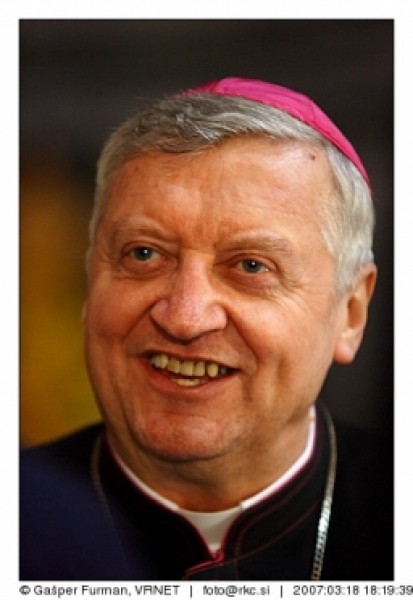
Cardinal Rode, Peter S. and Archibshop Uran (source and source)

Within a space of a couple of months, Slovenian Roman Catholic Church (RKC) shook all the way to its foundations. Seemingly out of the blue, former Archbishop (top-ranking cleric in Slovenia) Alojz Uran was ordered to completely retire from public life and leave Slovenia immediately. While no official explanation was given for expulsion of a very popular former Archbishop out of his homeland, it was soon speculated and later confirmed that claims of Uran having fathered a child are at the crux of the matter.

Uran responded first by heeding to orders from Vatican but was soon admitted to a hospital due to a worsening heart condition, prolonging his stay in the country. However, only a month or so later (mid-August), Delo daily, which broke the story on Uran, ran a bomb-shell of an article claiming, that a middle-aged German citizen of Slovenian descent claims that Cardinal Franc Rode was his father and publicly demanded a paternity test.

Now, if Uran story was huge, the Rode thing was a motherfucker-of-an-A-bomb–showed-up-your-ass-and-detonated type of story. You see, both Rode and Uran served as Slovenian Archbishops. Rode replaced the wildly popular Archbishop Alojzij Šuštar who lead RKC during the dying stages of socialism in Slovenia and into its first democratic years. Although very conservative, he was seen as a dove, someone who could be reasoned with. Enter Rode and the Church immediately became more aggressive. He regularly made headlines, promoting a rigidly conservative, high-visibility and very hardline political profile of the Church. In all honesty, he massively increased the political (and economic) clout of the RKC, culminating in a concordat between Slovenia and Vatican in 2004. But he also alienated the Church from the more moderate part of the flock. As a result, percent of Slovenes declaring themselves of Roman Catholic persuasion (not necessarily practising, but simply of faith) fell from 75% under Šuštar to 55% under Rode.

In 2004 and Rode was recalled to Rome to take over as Prefect of the Congregation for Institutes of Consecrated Life and Societies of Apostolic Life, in fact keeping tabs on various orders of the Church around the world. This he did with much gusto, which is something some of the more liberal nuns in the USA experienced first hand.

At any rate, Rode, who was made Cardinal by the new pope Benedict XVI shortly thereafter, was succeeded by Alojz Uran in Ljubljana. And this where the plot thickens. Under Uran, who always struck pengovsky as a Roman Catholic version of Friar Tuck, the flock began to swell again. But apparently Rode was none to happy to have been succeeded by a man with a down-to-earth-back-to-the-people agenda. Also, it was hinted lately, that Uran was opposing RKC’s financial excesses in general and the machinations of Maribor diocese in general. Without much success, but annoying quite a few people along the way. The straw, which seems to have broken the camel’s back, however, was Uran opposing using Church funds to pay for renovation of Goričane mansion, where Rode was planning to retire to after he bid goodbye to Vatican.

Thus a below-the-radar investigation was apparently initiated into Uran’s alleged fatherhood. While no names were named, the rumour mill went up to 11. Thus it was said that Uran apparently had a thing going in Šentvid area of Ljubljana and that everyone involved, including the kid, was pretty cool about it. Uran, for his part, denied ever having broken the vow of celibacy, but apparently bowed to Vatican. He was expected to be sent to Trieste, which – although just across the border in Italy – technically is outside Slovenia.

It was speculated early the whole thing is Rode’s payback for Uran being a pain in the ass. That the whole thing is a high-level semi-divine power play became apparent after one Peter Stelzer, 42, a German citizen of Slovenian descent publicly claimed that Franc Rode is his father. As with Uran, Delo daily had the exclusive, where the allegedly Cardinal’s long-lost son claimed that Rode, then a young vicar, knocked his mother up forty-two years ago and then left her, whereupon she, barely 18 years old, emigrated to Germany.

Rode’s reaction was most curious. He confirmed a relationship with Peter’s mother, but said that it was platonic and discontinued due to his heavenly call. As if… 😀 Additionally however, Rode hired a stellar lawyer, Nina Zidar Klemenčič, who – incidentally – also represented PM Janez Janša in various civil cases, including those tangential to the Patria Affair (which got its own twist today, by the way).

In the last few days the story got another twist, with Rode in principle agreeing to a paternity test which Peter S. demanded and said he’d have it done by the Ljubljana Institute of Forensic Medicine. However, Peter S. now says he wants the test done by a relevant German institution, citing concerns that religious persuasion of the head of Institute Jože Balažic would taint the process.

This will be fun to watch, although pengovsky would be very much surprised if the Rode – Stelzer paternity test came back positive, despite their seemingly strong physical resemblance. In fact, the only reason why this is mildly important to the general public is because the Church, from position of celibacy, takes it upon itself to approve or disprove of how other people’s intimate lives and family matters. Like it did in the Family Code debate. If either or both allegations turn out to be correct, this would be the final nail in the coffin of RKC’s credibility and morality.

Other than that, pengovsky doesn’t really care a pair of fetid dingo’s kidneys if either Rode or Uran (or both of them) fooled around. Quite to the contrary. I’d rather have clergymen screw consensually than screw little children forcefully or screw unsuspecting shareholders and investors out of their money.

As the old folk-wisdom goes, why does the vicar have a housekeeper? Just in case.


Enhanced by Zemanta

Trouble In Paradise

It’s the silly season and it shows. News is slow and it mostly consists either of Olympics, the continuation of eurozone crisis or wildfires. That and the ever louder coalition quarrels. In fact, days ago things got a bit ugly. And then some.


Picture almost unrelated (source)

While it has become customary for politicos to scuffle on Twitter along the coalition/opposition lines, friendly fire is much less common. An example of the former we could witness today, shortly after Police Commissioner Janko Goršek (the top cop) announced that he was leaving the post on 1 October. What is most probably a case of you-can’t-fire-me-I-quit! was more or less expected ever since Janša 2.0 came into existence. Police is too important a system to be left unto its own devices, no? You gotta have party hacks reliable people running it, if your boss is on trial for corruption charges and was somewhat humiliated by appearing on a TV show whose anchor was arrested a day later on blackmail charges.

Never the less produced a lively exchange between interior minister Vinko Gorenak and his immediate predecessor Aleš Zalar (who was acting minister after Katarina Kresal resigned in August 2011). Zalar tweeted that with this Gorenak is probably ready for interpelation proceedings while Gorenak shot back whether Zalar might be helping the opposition in drafting the document. It went downhill from there, with Gorenak finally tweeting that he only deals with Zalar as a sort of a hobby. Which can come across rather kinky, if you look at it from the right perspective 😉

But this is just a sideshow, albeit one with nasty effects coming later in the year. The real shit was happening between Janez Janša‘s SDS and Gregor Virant‘s Citizens’ List. The two coalition parties entered a bit of a turf war over who gets to appoint whom in various state-owned firms with SDS aiming to share as few spoils as possible. Virant made his displeasure known and earned a retort on official SDS Twitter account saying that “Virant can not pass a microphone without uttering stupidites”. Which is a nasty thing to say to the president of the parliament, especially if he’s your coalition partner.

But the real shocker came a week later. Contrary to all expectations, the government rejected draft budgets for 2012 and 2013, instructing minister of finance Janez Šušteršič (number two honcho in Virant’s party) to go back to the old drawing board. This was complemented with an official SDS tweet asking how can the finance minister be absent for a budget session of the cabinet

Now… In all fairness, the government is fully entitled to reject any draft document. It is what it does. Rejects and accepts. Furthermore, it is unusual for a minister to be absent when his documents are debated. But it has happened before. That’s why we have State Secretaries. To stand in when minister is not available. Also, given that state finances across Europe at this time look more like guess-work than real accounting, the rejection could be considered just a change of plans. However, the fact that Šušteršič is the architect of this government’s austerity plan and knows more about finances than the rest of the government put together (and that ain’t saying much!) combined with the above tweet amounts to nothing less than a public political dressing down of a man whom pengovsky already said is probably earmarked as the fall guy when thing will go badly wrong.

And badly wrong they will go. As you know, Slovenia’s credit rating was cut down recently to just a notch above “junk” which means that we are more or less fucked. Even the former happy-go-merry market fundamentalists the likes of Jože P. Damijan who made a name for themselves by advocating flat-rate tax during Janša 1.0 have come to their senses and are now opposing across-boar-austerity, instead advocating the Krugman-Roubini gospel of jump-starting the economy as the government’s top priority.

There’s trouble in paradise and I ain’t talking an Ernst Lubitsch film, if you catch my drift. Members of the self-styled “coalition to save Slovenia” are slowly but surely going for each other’s throats while the world around them crumbles to pieces. That SDS went after Virant yet again only days ago only further proves the point.

Enhanced by Zemanta

Getting Fired For Actually Doing Something?

Finance daily ran a story yesterday about PM Janez Janša is set to kick interior minister Vinko Gorenak and justice minister Senko Pličanič out of the government come Autumn. While the government communication office denied the rumours (PM Janša remains mute on the issue) the story might actually have legs given its proximity to last week’s scare about the vote of confidence.


In foreground: Senko Pličanič, left and Vinko Gorenak, right (Photo by Matej Družnik/Delo.si)

At any rate, a government reshuffle is quite embarrassing this early in the term of the current administration, but is also far from problematic. In fact, it has become something of a tradition for a Janša administration. Early on during his 2004-2008 stint at the top job Janša had to find a replacement for Jože P. Damijan, who resigned his post as development minister after only three months in office, reportedly due to falling out with then-finance minister Andrej Bajuk over (non)selling of NLB. Slightly off-topic: in hindsight it appears Damijan had a point back then and lost no time rubbing it in the face of his former boss (Google translate here)

It should also be said that neither Pličanič nor Gorenak (offically) have any knowledge of PM’s alleged bad blood, with Gorenak writing up a rather heavy rebuttal (again, google translation) but, interestingly, avoiding the finer points of Finance story. In fact, a lot of it is actually a classic non-denial.

But the gist of the story is somewhere else entirely. A week or so ago PM Janša appeared on Vroči Stol (Hot Seat) programme hosted by Vladimir “Vudu” Vodušek. What was basically a farcical re-run of a similar event four years ago would probably be forgotten soonest , had Vudu (now owner of a financially embattled Info TV cable TV station) not been arrested the very next morning on charges of extortion and blackmail, unofficially of a CEO of a hardware company. It was all highly embarrassing for the prime minister, who – according to the Finance story – went apeshit over not being told that Vudu was a target of a criminal investigation. And this is where things get interesting.

The only thing is that the PM is probably the last person on earth who can be told of an ongoing criminal investigation. In a democratic state politics stays out of police work. It takes the widest berth possible. Which is why Janša’s (again: alleged but not denied) reaction is highly symptomatic of how this administration sees this country: as a top-to-bottom controlled organism with no horizontally or vertically independent sub-systems and with the head knowing everything and making all the important calls. There’s a word for that and it ain’t democracy.

Minister Gorenak maintains that he never spoke to Janša about the investigation. Which is fine, even though one can understand the sentence as if he himself did have prior knowledge of the investigation (which he shouldn’t have, as the police is under his portfolio but not direct control). Which would – bizarre as it sounds – mean that interior minister Vinko Gorenak did something right for a change and is looking down the wrong end of a gun-barrel for it. Go figure. Not that he would be sorely missed, but still…

And as for minister Pličanič, he too is apparently getting the short shrift for doing too much rather than too little. According to media reports the past six months have seen (some sort of) results solely in the areas of financial austerity and public administration, the former being the portfolio of finance minister Janez Šušteršič while the latter is the domain of minister Senko Pličanič (both, incidentally, of Gregor Virant‘s Citizens’ List)

What Pličanič apparently didn’t understand was that he was meant to do as little as possible save perhaps a token effort here and there. He really should have gotten the message when the State Prosecution was detached from his portfolio (justice) and joined with internal affairs (ran by Gorenak). But as things stand, he seems to be poised to play the sad role of collateral damage.


Enhanced by Zemanta

Vote of Confidence: How PM Janša Just Screwed Entire Slovenian Politics Dry

Speculation was rife in Slovenia today that PM Janez Janša will tie a confidence vote to tomorrow’s vote on initiating procedures to enshrine the fiscal rule in the constitution. In less than twenty-four hours the country found itself in the middle of a political cliffhanger, since the government does not have the necessary two-thirds majority to change the constitution. It was obvious from the outset, however, that the whole thing was nothing more than an elaborate bluff, it’s primary goal not being mustering the votes necessary but rather a disciplinary measure, smoking out this government’s “internal opposition” and bringing them back in line for much more crucial votes which this government faces down the road.


(source)

Namely, the government of Janez Janša enjoys a stable majority in the parliament. The coalition has 52 votes (53 if you count the overly-indulging former PM Borut Pahor) and can pass legislation virtually at will. In fact, this is exactly what it is doing, as the parliament only this week passed 20-or-so laws, most of them under emergency procedure. Not that there was any real emergency, but the government asked for multiple quickies and the MPs who support it complied no-questions-asked. Such is the discipline within the coalition and there really is no need for Janša to test whether or not he has the support of the parliament.

That Janša was entertaining the thought regardless shows only that he is willing to (ab)use legal instruments to further his own grip on power. Tying the vote of confidence to a 2/3 majority would create a legal and political clusterfuck of epic proportions because it would mean the fall of a majority government without a viable alternative coalition to replace it. Which would probably suit Janša just fine as he thrives in an uncertain environment and would most likely end up on top again, even stronger. Truth be told, he most likely already got what he wanted and thus screwed the entire Slovenian politics dry.

Namely, earlier this evening an 11th hour compromise was reached, putting the vote on fiscal rule off until September, which places the debate conveniently close to presidential elections. And let us not forget this is not the first time he pulled a stunt like that. Back then he did it a week after Danilo Türk was elected president, this time around he tricked others (namely, president of the parliament Gregor Virant) into placing a debate a few weeks before the elections, possibly hijacking the debate entirely.

As an added bonus, he also forced the hands of Karl Erjavec (DeSUS) who was immediately ready to jump ship saying that he’s willing to be a part of any coalition and of Radovan Žerjav (SLS), who openly toyed with the idea of yet another early elections, excluding up front the possibility of someone else heading the government under the same coalition. Both Žerjav and Erjavec will pay dearly for their political amateurism. Additionally, Igor Lukšič of Social democrats made a bit of a blunder, saying that “if the going really gets tough”, the SD will support the fiscal rule. Well, the going got tough long ago and Janša now has Lukšič by the you-know-whats as well and the newly minted SD leader will have to spend a lot of energy to get out of this particular fix.

Right now, fiscal rule is the least of Slovenia’s problems. While not peachy, national finances are a far cry from that of Greece, Spain or Portugal (public debt in Slovenia right now is about 47% of GDP). This country has other problems: banking sector is cause for immediate concern with pension, labour market and health reforms coming in close second, as detailed here by Edward Hugh of Economonitor

That after six months in office Janša tackled none of the above (even the banks are on hold until Autumn) only further strengthens the point that the whole point of today’s exercise was purely political with the ultimate goal of not relinquishing power, but tightening the already firm grip on it. After all, why would someone who six months ago went to great pains to clinch the PM spot, suddenly just give it up. Especially since he has this huge millstone hanging around his neck…


Enhanced by Zemanta

Phone Hacking Slovenian Way

If you by any chance thought Slovenia is some sort of rump quasi-democracy with a crackpot neolib government, then you have the wrong idea, mister! In fact, this sorry little excuse for a country has everything big guys have, although you’re allowed to go pas assez cher, mon fils.

In fact, in certain aspects we’re very much like the United Kingdom. Not only did we have an allowances scandal, we have a finance minister who is forced to do an epic U-turn on matters of state finances and as of recent, just like United Kingdom we also have out very own phone-hacking scandal.


The incriminating text message. Interestingly enough, the background is red (gasp!) (source)

Interestingly enough, about a month ago, an article appeared on Slo-Tech.si community (fairly good Google translate), detailing vulnerabilities of several Slovene mobile operators and provided proof of concept about hacking the entire GSM grid individual phone numbers and the possibility to fake text messages and phone calls.

Days ago several members of Christian democratic NSi, a junior coaliticon party, received abusive text (SMS) messages calling them traitors and saying they’ll burn in hell for their position vis-a-vis the red star symbol. As both readers of this blog know, it has been the semi-official position of this government that the red star is a symbol of the tyranical communist regime and occupator Yugoslav army which fought to quash the fledling Slovenian state in the 1991 War of Independence. As such, the goverment went, the red star should be outlawed or at the very least excluded from the collective memory and remembance, especially from any and all official celebrations of Slovenian statehood.

Nevermind the fact that the Partisan guerilla fighters liberated Slovenia in 1945 under the red star banner, making the one of the few home-grown armed forces to defeat the Nazi and Fascist armies, hell-bent on erradicating Slovenes from the face of the Earth. Nevermind the fact that under the red star banner Slovenia was able to claim Primorska region as its sovereign territory, previously held by Italy as booty for switching allegiances in World War I. Nevermind the fact that under the red star banner, Partisan units were considered a part of Allied forces in World War Two, helping hundreds of US, British and other airmen, downed on their sorties during bombing campaigns over Nazi Germany.

Never even mind the fact that today Heineken brewery is using a red star as a part of its logo or that Crvena Zvezda (Red Star) football and basketball clubs from Belgrade are doing the same, as are countless other companies around the world, including (but not limited to) Texaco, Macy’s and even the State of California.

And last, but ceratinly not least, the only military compound in the capital Ljubljana was recently renamed from Franc Rozman Stane (commander of Partisan forces, killed in an firing-range accident in 1944) to Edvard Peperko who was the first military casualty of the Battle of Trzin (outside Ljubljana), one of the largest fire-fights between the JNA (federal army) and Slovene paramilitary Territorial Defence in 1991. The fact that defence minister Aleš Hojs, who decreed the renaming is a member of NSi, which troubled itself to defeat the (admittedly ill-concieved) designation of a new Ljubljana avenue after the late Josip Broz Tito only adds gravity to the issue. Which is why plenty of hoopla was raised when days ago prominent members of NSi received those abusive text messages. But the twist is that Jernej Vrtovec, Matjaž Longar and Andrej Cimperšek got these texts either from each other’s phone numbers or (in case of Vrtovec) from their own alternative number.

Obviously all hell broke loose, Vrtovec, Longar and Cimperšek denied the possibility of simply sending texts to one another and a police investigation was launched while Telekom Slovenje conducted an investigation into phone hacking allegations. Well, guess what: turns out their phones were not hacked but rather various web-services were used to emulate any given phone number. That such a feat is possible in the first place speaks volumes of the security measures within this specific cellular network in the first place (edit: apparently, this is something local mobile operators can not block. Thx @gbozic). But even more importantly this sheds new light on a similar incident months before last year’s elections.

Back then Melita Župevc MP (previously, of SD now of PS) SAID a call was made to her mobile phone using her own phone number. Given the fact that Župevc was at the time head of the parlimanetary inquiry on financing pro-SDS free “newspapers” prior to 2008 elections, she cried murder, claiming that she was being threatened and pressured. Almost immediately she became the laughing stock of the political right wing, with some even insinuating she’s delirious and hallucinating. And when their phones get allegedly hacked, they raise living hell as if it never happened before.

This government, despite facing a daunting task of handling the financial, economic and social crisis brought about by the 2008 crash, is making it its business to rewrite history and chase ghosts. Not only by banishing the red star wherever it sees one, but also by renaming army instalations which held the names of prominent Partisan leaders and screaming bloody murder when someone (perhaps even one of their own) does unto them what they laughed at when it was done unto others.

In fact, if you think Slovenia is a rump quasi-democracy with a crackpot neolib government, chances are, you’e not that far off.

Enhanced by Zemanta

Janez Šušteršič, Meet Reality

Reality seems to have caught up quite fast with finance minister Janez Šušteršič. The man who headed the government macroeconomic office (the aptly named IMAD) during the first Janša administration and refused to pick up the pieces after Jože P. Damijan, the would-be wonder boy of Janša 1.0 jumped ship after only 91 days in office, was forced to fork out EUR 381 million to recapitalise Slovenia‘s largest bank, the state-owned NLB.


Janez Šušteršič and NLB (source & source)

Well, to be honest, the state directly recapitalised the bank with EUR 320 million, while the remainder was coughed up by para-state funds KAD and SOD which is almost the same as if the state gave the money, only it looks better on the balace sheet. KAD and SOD entered the clusterfuck that is the NLB at the eleventh hour, after Belgian KBC bank refused to partake in the operation (after initially agreeing to the deal) and has thus seen its share in NLB shrink from 25 to 22 percent. The funny thing is that only months Šušteršič claimed that not a single euro from the budget will be used to recapitalise NLB. Which means the realisation that no-one will touch NLB with a ten-foot-pole must have come as a rude shock to our austerity-oriented finance minister.

In fact, given the ferocity with which Šušteršič and the rest of the sell-them-all-market-will-know-its-own gang were championing the “market approach” means that what we have witnessed vis-a-vis the NLB was nothing less than an about-face of epic proportions. In other countries, ministers get heavy flak for much less.

OK, fact of the matter is that NLB at this time is about as attractive as three-day-old road-kill and Šušteršič was basically looking down the barrel of a gun, faced with either pumping cash into NLB or hanging it dry. And we’ve seen what letting a bank go bust does, right? But there’s more: Not only did NLB need 380+ million of Tier 1 capital, it also has about three billion of bad loans on its books. And while Šušteršič maintains that most of these loans can and will be repaid, that is more or less eyewash. The bank will never see this money returned, because there is no way for companies who took out these loans (by far and large during the first Janša tenure, when the government encouraged expansionary economic policies) to return them. They don’t have anything to return them with. No competitiveness, no markets, no income, no way to pay the labour force, not even state contracts to offset the above and – finally – no earnings to finance their erstwhile debts.

So, yes, NLB will probably have to suck up losses of about three billion euro. Or about 8,5 percent of entire Slovenian GDP. That’s a lot. And that’s just the biggest bank. Other banks have bad loans on their books as well. Thus the finance minsiter and his boss, the prime minister can assure the country and the world, until they’re blue in the face, that Slovenia will not ask for a bailout of its banks. But the reality is that there will be a call made to Brussels sooner rather than later.

And if the U-turn on NLB recapitalisation wasn’t reason enough, the moment this country asks for a bailout will also be the moment when finance minister Janez Šušteršič will have to ask himself whether he’s fit to continue in this government. In other words: a request for a bailout should be accompanied by a letter of resignation.

The reason for this is painfully simple. Šušteršič positions on the issue, indeed his entire economic platform was about removing the state as a majority owner in key companies. This plan fell apart on the first rock it hit. Yes, NLB needed to be recapitalised and yes, the state is not necessarily a bad owner (although NLB was mismanaged time and again by politically appointed management). Having a the biggest bank in the system limp forward is preferable to letting it sink. But Šušteršič’s political positions which won him the mandate as an elected official, are in direct and blatant opposition with his actions. The two can hardly be reconciled which means that Sloveinan finance minister has a huge credibility problem. And a finance minister with a credibility problem is not something to be looked kindly upon. Just ask Franci Križanič.

But Šuštešič’s biggest problem is not his (lack of) credibility, but the fact that he is, unbeknownst to him, probably earmarked as the fall guy if things go badly wrong. This, at least, would appear to be case since Positive Slovenia announced it will start interpelation proceedings against the finance minister. Technically, an interpelation does not have to end with a vote on minister’s dismissal (although it often does). Instead, it is an instrument of ministerial accountability per se, forcing the minister to explain and defend his or her action.

Now, PM Janez Janša already called starting interpelation this early in the term “nonsense” and at least technically backed Šušteršič up (again, a lovely case of double standards as his party filed an interpelation against Katarina Kresal less then three months after she took office in 2009). But since DL and SDS found themselves on opposite sides on quite a number of issues in the past few days (mostly stemming from the “red star issue”) Šušteršič can be sure that he’ll be made to pick up at least part of the tab.

It seems that the finance minister started this term knowing what his priorities are and falsely assumed that these are other people’s priorities as well (we’ll neglect that these priorities are dubious at best). When challenged about past economic policies of coalition parties in a recent interview with Mladina weekly, Šušteršič answered that he doesn’t care about who did what in the past but is rather interested in what this government will do. And this is the gist of it.

Šušteršič naively assumes that somehow it’ll be different this time around. He really should know better than that. The prime minister is the same. Most of the coalition parties are the same. Most of the key players are the same. Even the problems are the same. How then could results be any different? Remember: I’m not saying that either state or private ownership are inherently bad or good. But the speed at which stated goals of this government and its financial minister have disappeared into thin air is somewhat breathtaking.


Enhanced by Zemanta