Easy Come, Easy Go

As the world economy is going down the shitter, Slovenian financial sector is along for the ride. Companies which as much as six months ago rocked the place and were seen as major players in everything from food industry to media are falling apart faster than you can say “Bohemian Rhapsody“. Naturally, we’re talking about Igor Bavčar and his Istrabenz and (at the moment to a lesser extent) Boško Šrot and his Laško brewery. Both Istrabenz and Laško have been targets of MBO’s, executed by Bavčar and Šrot respectively. With a little help from their former friend and his government they managed to get a carte blanche for buying out companies they ran. But as they lost favour with former PM Janez Janša they were styled as tycoon, with Boško Šrot being the main target of Janša’s revenge, for snatching Delo newspaper – a trophy much coveted by Janša – from under his nose. Igor Bavčar, on the other hand escaped rather unharmed as he and Janša were old war-buddies.

20090407_bavcar.jpg
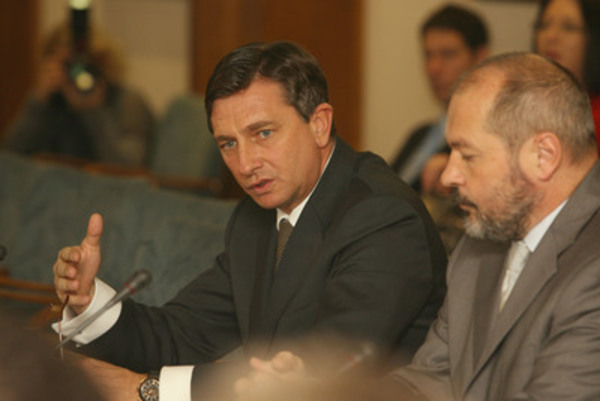
Igor Bavčar. Not Happy. (source)

But in the end it was Istrabenz which crumbled first, declaring insolvency in the middle of last week. The company has most of its assets invested in financial markets and suffered terribly from markets going south. Which would have been bad enough had things been orderly. But Igor Bavčar ran up an enormous debt, money which he used to expand and invest (unwisely, as it turned out) but also to finance his MBO – and in doing so he ran up a debt of about € 900 million (yes, nine hundred million euros), amounting to about 85% of the value of the company. Which is fucking bad and a clear case of casino economy.

Bavčar got in the game far too late stayed in for far too long. In the end his fortunes turned against him and his assets all but evaportated. At which point the banks got involved and wanted their money back. But there was a catch. For € 900 million of borrowed money Bavčar put up only € 200 million worth of assets, meaning that the banks gave the remaining 700 million just like that, hoping – just like Bavčar did – that capital returns will be big enough and will last long enough that extending a credit line exceeding the first US bailout package will not seem like a spectacular stupidity.

Well, it does.

As Istrabenz’s stock went into a freefall, crashing at a mere eight percent of its peak value, bankers finally got off their asses and started making nervous noises about their money. The fact that the company’s largest creditor, the Nova Ljubljanska banka (NLB) is partly owned by the state only complicates matters further. And then there are Istrabenz stockholders, who own a whole lot of worthless stock and must include it in their balance sheets. Among other things this has contributed heavily to Petrol, a partly-state owned oil-and-energy company to post a loss for the first time in the history of independent Slovenia.

Some are tempted to say that Istrabenz is too big to fail. Indeed, if it goes down the banks will lose the better part of those 700 million and it is quite possible that the government would have to use taxpayers’ money to plug the hole, a scenario Slovenia has once seen already – when the government of Janez Drnovšek opted to rid NLB and it’s Maribor rival NKBM of bad debts using taxpayers’ money and keep them rather than sell them dirt-cheap under an IMF dictate to some multinational corporation. On the other hand, some say that banks wouldn’t suffer as much and that Istrabenz should declare a bankruptcy, get rid of toxic assets and start afresh.

And now the banks on one side and the owners on the other side are quarreling about how to salvage the situation, whereas they’re mostly trying to salvage their face. Banks claim that they are the “economic owners” of Istrabenz, while true owners obviously dispute that and manoeuvre to have their people control the Supervisory board. Not that they did a brilliant job of supervising thus far.

And finally, there’s Igor Bavčar, CEO of Istrabenz whose share in the company he bought out is more or less worthless, but is reluctant to leave the post, just as a gambler doesn’t want to leave the table as long as there’s a chance of winning the big one.

But while Igor Bavčar is at the moment the most prominent of fallen financial angels, he is by no means the only one. Boško Šrot of Laško Brewery is apparently facing a similar fate, as is the investment industry as a whole. Apparently various investment firms, big and small, ran up as much as € 2.5 billion in debts, mostly putting up their investments as collaterals. And since the stock-market went down the drain, there is a real danger of these debts becoming highly toxic.

2.5 billion is a lot of money in Slovenian terms.

Things To Chew On A Saturday Morning (Vol. 5)

20090405_blog.jpg
(source)

It’s over — we’re officially, royally fucked. No empire can survive being rendered a permanent laughingstock, which is what happened as of a few weeks ago, when the buffoons who have been running things in this country finally went one step too far.

Matt Taibbi in The Big Takeover (Rolling Stone magazine, via dr. filomena)

A marvelous if rather worrying read.

You Can’t Fool All Of The People All Of The Time

Minister of interior Katarina Kresal yesterday – as expected – survived the interpellation (effectively a vote of no confidence) called by Janez Janša’s SDS.

20090402_kresal.jpg
Katarina Kresal making her rebuttal. In the background: PM Pahor, ministers Svetlik and Lukšič (source)

Officially, the vote was called on the basis of Kresal wrongfully implementing the decision of the Constitutional Court concerning the so-called erased (note the “so-called” manoeuvre) saying (among many wonderfully stupid things) that issuing decisions on permanent residence will generate a wave of suits against the state which could amount to as much as a billion euros in damages and that The Quartet is solving an unimportant but potentially costly problem at a time when most people face economic hardship.

There were other rhetorical bravuras, mostly delivered by Janša’s chief attack dog and Goebbels-wannabe Branko “Gizmo” Grims, who took center stage during 14+ hours of parliamentary debate which was more or less a zillionth re-run of the same old story. However, this time the old stance of “erased-were-collaborators-and-deserved-what-they-got” was supplemented by linking their potential claims for compensation to economic crisis, saying the country cannot afford costs of judicial processes by 25.000 people and (what horror!) pay for damages.

Which is yet another example of how SDS pictures the rule of law: selectively.

On the other hand, Kresal enjoyed what was probably her most glorious moment to date. She delivered an extremely strong speech debunking claims of the opposition. But most importantly, she maintained that the issue goes to the very heart of human rights and that there should be no ifs and buts about it, if we are to have a rule of law in Slovenia. All in all she gave a very strong performance and came off as being able to hold her own. Which means that she made leaps of progress since she entered Slovenian politics a little more than a year ago.

As for SDS’s manipulations with the issue at hand, Kresal repeated a sentence by Abraham Lincoln and much later by Bob Marley, both of whom said that you can fool some people sometimes, you can even fool some people all of the time, but you can’t fool all of the people all of the time.

Not that this is the end of it. The opposition said that they will have the parliament form an parliamentary investigative committee which will investigate whether the issue of the erased is being solved properly. Which is just another way of saying that they will keep the issue on the back-burner until next election cycle when you can be sure it will explode once again, but in a much tougher economic environment.

They did it with the Roma in 2004 and won the elections. Question is will they fool enough people in 2012.

Slovenia Ratifies Croatian NATO Entry

20090331_ratification.jpg

Yesterday Slovenian President Danilo Türk signed the Law on ratification of Croatian entry into NATO. This ended almost two months of speculation which started after Janez Janša refused to support the entry if the coalition didn’t support a cooked-up version of 2007 Annual Account. This was followed by a referendum petition which brought together serial petitioners, hooligans and self-proclaimed defenders of Slovene border and nearly caused a major international embarrassment for Slovenia, despite the fact that Croatian government did a lot to prove the petitioners’ point.

In any case, the referendum petition failed spectacularly as Party of Slovene Nation (the petitioners) collected only around 1100 signatures supporting their bid, which probably causes top echelons of Slovenian politics to give an audible sigh of relief. The whole episode was enough, however, to re-ignite the debate on referendum legislation where things are far from over.

All that’s left now is Croatian EU bid, where Slovenia and Croatia have a slightly bigger problem.

Don’t Panic!

As of Monday the Government Institute for Macroeconomic Analysis and Development – the aptly named IMAD – published new forecasts for Slovenian economic growth.

20090326_blog.jpg
PM Borut Pahor and finance minister Franci Križanič (brushed up from source)

Growth? Think again…

IMAD predicts that Slovenian economy will shrink by 4 percent in 2009, which would apparently be the largest economic downturn in history of independent Slovenia. Apparently even independence itself and consequent loss of Yugoslav markets didn’t hit Slovenian economy as bad as this. New unemployment projections now show that as much as 100,000 people might find themselves being laid off, which would bring unemployment to about 9 percent.

Admittedly, the people at IMAD are not the quickest of cats at the best of times (its former director some three years ago famously said that there is no way for a price of a barrel of oil to go above 100 dollars) and they have maintained until recently that Slovenia will experience minimal growth, but this prediction is a much-needed reality check. It means that the government of Borut Pahor will have to dig deeper, faster and harder than anything we’ve seen to date.

Among other things this means that rebalancing of the budget which the parliament is expected to approve today is more or less worthless and that finance minister Franci Križanič and his team will have to go – in the words of Wile E. Coyote – back to the old drawing board. When asked about it last week, Križanič said that the crisis will turn in the middle of this year. The problem is that he sounded as if the crisis must turn in the middle of the year. As if they just spent their last bullet.

PM Borut Pahor adopted a hitchiker’s attitude as is saying (in nice, big, friendly letters): Don’t panic!. Some quasi-experts think otherwise and say it’s time to panic. Both pieces of advice are wonderfully useless.

Lovely…

How The Mighty Will Have Fallen

On Sunday Borut Pahor was re-elected as president of Social Democrats. That in itself is not news. The fact that he had no opponent and that he had just won the election made his re-election in the party a given. What was interesting, though, were elections of the party vice-presidents.

20090325_blog.jpg
Borut Pahor, Igor Lukšič and Patrick Vlačič (source, source and source respectively)

The party has four VPs, two men and two women. The latter are Madja Potrata MP and Alenka Kovšča and their elections came very low on the Surprise Scale as well. The interesting stuff was going on in the men’s corner, where three candidates ran for two VP posts: Miran Potrč MP, minister of transport Patrick Vlačič and minister of education and party ideologue Igor Lukšič.

While Potrč’s election was all but guaranteed as he is enormously respected within the party, the battle between Vlačič and Lukšič bore huge significance. Not in the least because PM Pahor fell out with Lukšič over his candidacy for the post, saying that it would be improper for an education minister to be a high ranking party official. In between lines this read that education should not be an ideological battleground between left and right. Interestingly enough, just prior to its convention (a congress, as these gatherings are known in Slovenian political terminology) Pahor fell out with Vlačič as well. The latter had – in his capacity as minister of transport – the management of Slovenian Railways removed and had the Supervisory Board appoint a new CEO, but without a public tender. This led to numerous speculation that the new CEO Matic Tasič was appointed for his political affiliation rather than for his competence. Whether or not that really is the case, remains to be seen, but the move flies in the face of Pahor’s promise to run a transparent government.

But nevertheless Pahor made it obvious that he’d rather see Vlačič than Lukšič as his party VP. Lukšič ran for the position nevertheless and lost spectacularly as delegates at the congress heeded to wishes of the PM. Upon losing Lukšič (a political scientist) said that the result shows that a “form of corporativism has emerged and that is not good for Slovenia (…) The party became interesting for some circles which have now established a power-base within the party” and added that the emerging generation is extremely ambitious and demands immediate results.

To put things into perspective: Igor Lukšič is the brains behind Borut Pahor. Widely described as the party ideologue he was Pahor’s shadow ever since the latter became president of the party youth organisation some seventeen years ago. It was Lukšič who introduced Pahor to Anthony Giddens’ Third Way and together they styled the Social Democrats after Tony Blair’s New Labour. Igor Lukšič, Ph. D. worked from within the academic environment, where he is an established and oft-quoted political scientist as well as an influential professor at the Faculty for Social Sciences (FDV), contributing heavily to the perception of FDV as a “red” faculty.

In other words: if Pahor is the form, Lukšič is the content. For better or for worse.

And now, after becoming the PM, Borut Pahor got rid of his ideologue. That in itself is not bad. It is a political decision by the party leader which he may or may not come to regret. After all, it is not as if Lukšič can just switch parties and become an ideologue for the competition. Furthermore, it is entirely possible that Lukšič spent himself and that he is fresh out of ideas for the party which – after winning the elections – needs to reinvent itself. Lukšič says that with him as VP Social Democrats could achieve even better results in four years’ time, but you sort of expect him to say that.

So Lukšič’s defeat is not a problem. The problem is Patrick Vlačič’s victory. His rise within the Social Democrats was meteoric. Nowhere to be seen five years ago, he started appearing as the party’s expert on transportation (although he’s a lawyer by education) and his rise has continued unabated ever since. Some see him as the younger version of Borut Pahor (i.e.: pretty but no content), to others he is an unscrupulously ambitious politicians who is quickly establishing his power-base and will not mince over choosing means to reach his aims. However, pengovsky is bothered by both of these pictures. Namely, there is one critical element missing from Vlačič’s track record.

Defeat.

Vlačič seems on top of his game. He controls a powerful portfolio, he can sack CEOs of state transtportation companies, he can decide which projects will get priority, in short, he is the Big Transport Kahuna in town. On top of that he just became his party’s second in command and is considered as heir-apparent. But – as Igor Lukšič will happily tell you – Newton’s laws apply to politics as well. In this case, what goes up must come down. Patrick Vlačič may feel that he is establishing his power-base within the party, but pengovsky has a feeling that it is in fact Vlačič who is being used by special interests to gain favour with the new government. The question is whether Vlačič is in on the plot. But he is probably also being used by Borut Pahor, who conveniently got rid of Lukšič but will most definitely not tolerate leadership challenges by a relative newbie and will bring him down crashing if he doesn’t toe the line 24/7.

Therefore, getting Patrick Vlačič elected as VP served nothing else than removing Lukšič from the top echelons of the party. It may be the first step in the younger generation taking over the party, but even if this happens, Patrick Vlačič will not be the one succeeding Borut Pahor. It’s just that he doesn’t seem to realise that.