Rewriting History

20090312_blog.jpg
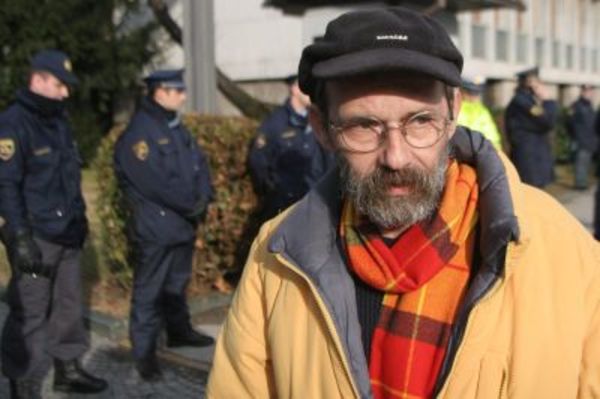
Members of Home Guard swear allegiance to Hitler in Ljubljana stadium, 1944 (left, source), Aleksandar Todorović during a protest of the Erased in front ot the Parliament, 2006 (right. source)

As of 2004 historians estimate that some 14,000 Slovenes were killed post-war summary executions. Around 11.000 of those were members of the Home Guard, a collaborationist army formation. Being held as “enemy combatants” (no, Bush&Cheney didn’t make that up, the Allies did), they were stripped of any legal status, denied due process and as such fell victim to post-war revenge. Fact of the matter is that although they were collaborators, their act of treason should have been proven in a court of law.

As of 2009 it is clear that some 25,000 people were erased from records of the ministry of interior. Of these some 450 were in some way connected to the enemy Yugoslav Army. Suddenly stripped of their residence, their documents were invalidated and they found themselves without any legal status and virtually defenceless fell prey to continuous outpouring of nationalism, revenge and violation of human rights.

Certain political elements now flock en masse to the latest scene of the post-war revenge, where they call for nothing less than rewriting of history, presumably hoping that acts of treason and collaboration would somehow be redefined as profoundly patriotic. At the same time these very elements simultaneously deny that the erasure ever took place and claim that collaborators are being rewarded for their treason.

No wonder reconciliation is not possible. If siding with the occupator is patriotism and failing to get your papers in order is treason, we have a long way to go.

Reconciliation

sprava02.jpg
Image from Reconciliation ’04 – a computer game* by Mladina weekly (source)

A joke from the socialist times, naturally.

Two brothers fought the war on opposing sides. The older joined the Partisans, the younger joined the Home Guard. When the war was over, the older, although he was a decorated hero, couldn’t get a decent job. He kept being pushed around as a janitor, doorman and the likes. The younger brother, however, went on to become general manager of a successful company. How was that possible?

Simple.

The older brother had a problem, because his brother was a member of the Home Guard, whereas the younger had great credentials since his brother was a decorated war hero.

:mrgreen:

*The game is a tetris parody of the partisan/home guard rift. It is marvelously politically incorrect, as you can pick which side will you be throwing in the pit. Or you can throw them both. 😀

Coming To Terms With Our History

Apparently there are some 550 inter- and post-WWII graves in Slovenia. Some are invidiual and some are more-or-less mass graves. One of them was uncovered, following a long excavation, in the vicinity of Huda Jama in the middle of last week. Located in Laško municipality (yes, the beer), Huda Jama was a mining hamlet which was long abandoned. Until last week only a handful of people knew that the mine holds things much more horrid than coal.

hudajama.jpg
Mass grave at Huda Jama (source)

As more avid visitors to this blog know, Slovenes are unable to bury our dead. There are numerous reasons for that, including (but probably not limited to) the fact that mass murders were a more or less closely guarded secret under socialism and people only spoke about it in closed circles, but also due to the fact that the losing side, the Home Guard, which – for one reason or another – collaborated with Nazi and Fascist occupators is trying to use the post-war mass murders as justification for collaboration, conveniently omitting the fact collaboration came first and summary executions followed.

THE MESS

But if it were really that simple, it would be more or less a closed case of Slovenian winners taking it out on Slovenian losers, with the latter crying foul 65 years later. Obviously it is not that simple. It never is. As more and more graves and surrounding facts are uncovered, the picture grows ever more complex and unpleasant for everyone.

It is generally accepted fact that World War II ended on May 9, when Nazi Germany surrendered to Soviet Russia (following a surrender to Allies a day earlier). That may be true for most of Europe, but in Slovenia the fighting continued until May 15 1945 as German troops and their collaborators from the Balkans and the Caucasus were trying to make a dash for British-controlled part of Austria, trying to evade capture by either Yugoslav or Soviet army (the latter generally avoided Slovenia entered it briefly only in Prekmurje, at the very north-east end of the country). Retreating German army was closely followed by its various collaborators from all over the Balkans. Chetniks, Ustasha, Home Guard and various others knew that their collaboration with the enemy will not go unpunished. Some collaborationist units made it across the border and some didn’t. And even those who did, were returned to Yugoslavia, where they met their demise, usually without due process. Not that due process was a luxury they could hope to have been extended. The Second World War, one of the most dehumanizing experiences in modern history was over and what little of humanity there was left, it fell prey to revenge of the victors who prevailed against all odds, themselves mostly sentenced to extinction by the occupators and happily persecuted by the collaborators. And while the debate in Slovenia is raging mostly between Partisans and Home Guard (domobranci, the collaborators), the nationality of vicitims of these summary executions is varied. As was – it seems – the nationality of the executors.

Namely, as of late the debate is focusing on finding the people responsible for the executions, which is no easy task after six-and-a-half decades. Given the fact that in Slovenia the issue is highly politicised, has completely permeated the political discourse (ha! My studies weren’t in vain after all!) and has a habit of occasionally hijacking it entirely, every debate tends to be explosive even after 65 years and makes one think that if 80-year-olds can be at each others’ throats after all these years, the level of hatred during and after the was must have been incredible.

WHO DID IT?

And so every discovery of a mass grave is used by the losing side, usually associated with the political right wing, to try to prove the fact that it was the victorious side who were actually the bad guys, whereas they were only defending Slovenia. This is immediately followed by all hell breaking loose with the victorious side, usually associated with the political left wing, pointing out (in my opinion rightfully) that it was them (partisans) who fought against the Germans and Italians and that collaboration is a really strange way of defending a country doomed to be erased from the map.

As a result inter-war and post-war graves tend to get mixed up in the debate, which is sad, because during the war both sides committed atrocities, often outdoing one another. Cynical as it may sound, this is “normal” during a war and it was especially normal during WWII, even more so in the Balkans where centuries-old grievances tend to surface during any blood-letting. But if inter-war massacres can be discarded for a moment, this leaves us with post-war massacres, like the one at Huda Jama, committed in the months immediately after the war.

By the final stages of the war various Yugoslav Partisan units (including Slovenian) were already transformed into a regular army under centralised command. And as the Germans and their collaborationist units were retreating, they were closely followed by Yugoslav 3rd army under the command of General Kosta Nađ. This went on from Srem in Vojvodina (north of Serbia) to Slovene-Austrian border, with some elements of his army going over the border and liberating Celovec/Klagenfurt and Pliberk/Bleiburg, among other areas. Nađ’s 3rd Army was apparently comprised of units of all Yugoslav nationalities and it is safe to assume that units under his command were tasked with executions. Furthermore, similar operations by other belligerents in WWII suggest that this was done by a small number of specially motivated units and not by the regular battle-weary forces.

POLITICAL FALLOUT and DEFAMATION OF HISTORY

But rather than looking for people responsible in that general direction and giving proper burial to the victims, the debate in Slovenia is again shifting to attempts to decriminalise collaboration and shift the blame to both sides, saying that “everybody is to blame”. Indeed the latter sentiment has become dangerously familiar in the last few years, because it equals collaboration with post-war massacres. Which is of course a defamation of history. As a result, Slovenian parliament was repeatedly unable to pass a law on victims of inter-war and post-war violence which would hopefully close at least one (political) chapter in this debate and allow this nation to come to terms with its own history.

To illustrate just how volatile the atmosphere surrounding this issue is, take the Prez who on Sunday – when asked to comment on it – said that he will not talk comment on second-class issues. When he was additionally asked whether post-war executions are a second class issue, he answered that this goes for political manipulations of the subejct. This was enough to cause an uproar with SLS demanding his apology or immediate resignation. Yesterday the President had to clarify his position saying that post-was executions were not a second-class issue, but that political manipulations are a second-class issue.

WHAT TO DO ABOUT IT?

It is time to bury our dead. It is high time to find out who is responsible for post-was deaths. It is also high time to stop demands that victors of WWII apologize to wining the war. But it seems that reconciliation of a nation divided is impossible. Nobody illustrates that more than Janez Stanovnik and his cousin Justin Stanovnik. The former is leader of the Partisans’ Veteran Organisation, while the former is one of the more prominent spokesperson for Home Guard Veterans. Cousins, who – together with four other people – appeared in yesterday’s programme on state television and would not refer to each other by first names.

But perhaps sad chapter in Slovenian history can be closed with the help of victims of another sad chapter of our history. The first person to enter the Huda Jama mass grave last week was Mehmedalija Alić, also a guest on the programme, a mining expert who was one of the 25.000 of the Erased and who lost most of his family either in WWII or in the Srebrenica massacre. The symbolism of the moment could not be more telling. A man whose family was erased from physical existence by warfare in the Balkans and who – by no fault of his own – was erased from bureaucratic existence by a country which claims to be heaven on Earth is now bringing that same country to terms with its own history. You can only do that if you’ve come to terms with your own personal history. The legendary Boris Dežulović has a brilliant piece on this man (via dr. filomena, Croatian only)

HOW TO GO ABOUT IT?

Surprising as it may seem, I completely agree with Bernad Nežmah, a right-wing columnist who said that the mass grave should be left exactly as it is. As a reminder of the past, present and future, when the word “traitor” overshadowed the concept of human rights

Things To Chew On A Saturday Morning (Vol. 4)

20090607_rec.jpg

With economic activity contracting in 2009’s first quarter at the same rate as in 2008’s fourth quarter, a nasty U-shaped recession could turn into a more severe L-shaped near-depression (or stag-deflation). The scale and speed of synchronized global economic contraction is really unprecedented (at least since the Great Depression), with a free fall of GDP, income, consumption, industrial production, employment, exports, imports, residential investment and, more ominously, capital expenditures around the world. And now many emerging-market economies are on the verge of a fully fledged financial crisis, starting with emerging Europe.
(…)
the U.S. financial system is de facto nationalized, as the Federal Reserve has become the lender of first and only resort rather than the lender of last resort, and the U.S. Treasury is the spender and guarantor of first and only resort. The only issue is whether banks and financial institutions should also be nationalized de jure.

(source: Nouriel Roubini for Forbes.com)

Lovely.

By the way, since when does leaving a third of the troops on the ground count as a pullout?

A Slap On The Wrist

Remember the Prez’s flying fiasco? To offset the damage, President Danilo Türk asked the Court of Audit to pour over the rent-a-jet procedures which ran up a bill in excess of 90,000 euros. At some point the Anticorruption Commission got involved as well and its findings (published on Tuesday) were intriguing to say the least.

20090305_tramte.jpg
Stojan Tramte (source)

Anti-corruption Commission, headed by Drago Kos, found that while the President legally does not have in influence and power in rent-a-jet and other procurement procedures (and is therefore innocent of any wrongdoing), it was his office which should have exercised more vigilance, restraint and sound economic thinking when organising a flight. Specifically, it failed to perform even basic inquires about prices with flight operators in Slovenia, thus paying far more than the market price at the time of procurement of service. Thus the commission found that the actions of the person responsible are consistent with legal definiton of corruption (failure to act leading to inappropriate use of public funds). However, the Commission also found that no criminal act was committed.

As a result Stojan Tramte, Secretary General of the Office of the President offered his resignation to President Türk on the same day. Yesterday the Prez refused the resignation, citing Tramte’s efforts to improve the procurement procedure within the Office after the affair broke out. The Prez also pointed out that the Commission found there was no criminal activity and that he has already officially reprimanded Tramte immediately after it became obvious that public funds were not spent wisely.

So the whole thing basically amounted to a slap on the wrist. As expected the Anticorrupton Commission went above and beyond the call of duty to clear the Prez of any wrongdoing, pinning the blame on people in the Office. Nothing new there. But although it was probably agreed in advance that Tramte would offer to resign and the President would refuse the resignation, I still like the fact that he indeed offered to resign. Usually in Slovenia public officials excel at shifting the blame around, but Tramte bit the bullet and took the blame.

Obviously this doesn’t make everything alright, but it does hopefully set a precedent for future cases. Both in terms of officials taking responsibility for their actions as well as in terms of actually closing a corruption charge case.

Going About It The Other Way

Yesterday pengovsky busied himself with taking apart a particular initiative to change referendum legislation. The post ended with a call for surgical precision when changing instruments of direct democracy, which implicitly means that even pengovsky recognises certain things must be amended.

20090304_referendum.jpg
(source)

I know it’s lame to re-post one’s own comment, but I really think that rather than changing the referendum legislation, the parliament should change its Rules of Procedure (article 169) and no longer ratify multilateral international treaties, where Slovenia is no the primary signatory in a form of a law, unless the treaty falls under the provisions of Artice 3a of the Constitution.

In my opinion this would be quite enough to prevent small bands of referendum raiders from wrecking havoc on key foreign policy decisions. If rules regarding the number of signatures needed to start the process were amended as well (from 2500 non-verified to, say, 7000 verified signatures), things would be just peachy.

And that’s all you need. I think abuse of referendums for one party’s political goals would diminish greatly since it would demand a greater effort on the part of the referendum bidders, leaving the state with more important referendums, where attendance would be higher as well, regardless of the day the vote would be held.

The Road To Hell Is Paved With Good Intentions

In the wake of the initiative to hold a referendum on Croatian NATO entry, changes the referendum legislation are again being mulled.

20090303_zares.jpg
Gregor Golobič and Cveta Zalokar Oražem of Zares pour over referendum legislation (source)

For starters, just a quick update: After a week of signature-collecting, the proponents of the referendum collected only about a 1000 signatures. As you know, they have 35 days to collect 40,000 signatures, meaning they’d have to collect more than 10,000 signatures a week, meaning they’re falling well behind. Provided that an unknown benefactor does not come to their organisational rescue, the SSN’s referendum bid is as good as dead.

However, should they somehow succeed, the results of the referendum would be binding, meaning that the parliament would not be allowed a decision contrary to the results of the referendum sooner than a year from the referendum. This is an important difference from the referendum on regions, which we followed closely on this blog.

As things stand now, there are four different rerefendums possible on a national level: a referendum on constitutional changes, a referendum on international relations (held when Slovenia joined EU and NATO), a consultative (non-binding) referendum and a legislative referendum.

The relative ease of initiating a referendum bid has time and again sparked the debate on whether or not the conditions for a referendum should be toughened. It is generally agreed that of ten-or-so referendums which were held in Slovenia, most if not all were either

-dealing in marginal issues, concerning a limited circle of population
-dictate of a loud minority over a silent majority
-political ploys for circumventing the will of the parliament by a political faction that wouldn’t take no for an aswer

or any combination of the above. Thus calls for a change in legislation have been frequent are ever louder. Especially in recent days, after a marginal party presented some 5000 signatures calling for a referendum and forced Slovene-Croat relations (which aren’t peachy to begin with) to a grinding halt.

A legislative referendum (the subject of today’s post) can be called for the parliament itself, upon the motion either by the government, the proponents of the debated law, a parliamentary club or by ten MPs. In every case the parliament votes on the motion. Additionally, the referendum can be called, without the parliament voting on it, by a third of the MPs, the National Council or by 40,000 voters presenting their verified signatures. The last provisio is also the most unpredictable, as only 2500 non-verified signatures are needed to start the whole procedure, meaning that marginal groups with slightly too much time on their hands can wreck havoc in a sensitive political climate.

It was also because of this that some parties, most notably Gregor Golobič‘s Zares called for changes in the referendum legislation. Specifically, they call for a turnout quorum below which the results would not be valid, a ban on referendum on basic human rights and deciding on one or two days in a year when all outstanding referendums are to be voted on. They also called for toughening rules collecting the initial 2500 signatures.

Pengovsky disagrees with most of what was proposed, both in terms of general principles as well as in terms of specific potential problems adoptions of the proposal would create.

First and foremost, pengovsky thinks this country has had enough of systemic changes aimed at achieving a specific goal. We’ve seen enough of this during Janša’s rule. One of the more blatant example of that was the change in legislation on financing municipalities where the City of Ljubljana was deprived of 57 milion euros overnight just because the wrong man was elected mayor. The referendum legislation might not be perfect, but changing it now, because a bunch of neo-Nazis took advantage of if would be like changing the off-side rule because your defenders are not fast enough.

Secondly, the very idea of a validity quorum, although practical under normal circumstances, is utterly misguided. Since the power to rule rests with the people and it is executed directly by popular vote, it is unfathomable that this power would come into effect only after a critical mass of people would have attended the vote. Imagine that the quorum is set (for argument’s sake) at 40% turnout. This would mean that if 39,9% of people attended the referendum would be invalid and that although they took the trouble to execute their sovereign right to a vote, their vote doesn’t count. On the other hand, if 40% had attended (and, again for argument’s sake, 3/4 of votes would be in favour), then the referendum results would suddenly be valid, although only 30% of all voters voted in favour.

The other side of the coin of course is that as little as 10 percent of the voters can attend (as happened with the referendum on regions). But if the other 90 percent did not bother to attend, who’s to say that the votes of the 10 percent who attended count less? Yes, there were a number of silly referendums like this, with criminally low turnout. But it is not as if those who stayed at home did not have a chance to participate. If they chose not to, then they put the decision on the matter in the hands of their fellow citizens. Period.

Furthermore, a turnout quorum could actually lead to more unnecessary referendums rather than discouraging them. It could become the perfect tool for stalling the decision making process: calling a referendum that you know will fail, thus eliminating any fear of actual legal consequences, but nevertheless making life infinitely more difficult for the other side. Like

Moreover, I can totally imagine a scenario, when elections are nearing and a political or legal impasse is reached (such as, say, should mayors be banned from serving as MPs) which can only be solved on a referendum. A definitive decision would be is needed to ensure that elections were held on time and under such a scenario a turnout quorum would only add to the confusion rather than clear things up.

A variation of the last argument goes for the proposal to have to days a year set to vote on all outstanding referendums. This could do more harm than good, as a particular decision on which a referendum was called could be put on ice for as much as six months. Right now the “incubation” period is around 50 days. Imagine that this provision would already be in place and that (again, for argument’s sake) referendums were to be held on 21 March and 21 September. In case of Croatian NATO entry the referendum could be held only on 21 September, unnecessarily prolonging the issue which needs to be settled as soon as possible.

Banning a referendum on human rights is an altogether different proposal and I support it fully. The trick is, that it is already in place. Namely, under Slovenian system human rights and basic liberties are executed based on the constitution itself and you cannot have a referendum on that. For example, you cannot have a referendum on the freedom of speech. Were you to hold such a referendum, it could easily be defeated in the Constitutional Court. It is true, however, that someone would have to contest such a referendum, because the Court does not have the authority to pro-actively judge legislation, but only when asked to. So, banning a referendum on human rights would have no practical effect.

And lastly, the idea of toughening the rules for collecting the initial 2500 signatures: this could be very well put in place. Namely, if a proponent of referendum seriously expects to collect 40,000 verified signatures in 35 days (verified as in signed in front of an official), then he/she should have no problem in collecting, say, 7000 verified signatures in seven days. The way things stand now, a proponet of a referendum needs only a list with names, addresses and signatures of 2500 individuals which may or may not be of legal age and may or may not be Slovenian citizens. Sure, all signatures are checked against records, but there is no guarantee that someone didn’t just copy the names out of a phone book and faked the signatures. Of all four proposals this one seems the most reasonable.

The road to hell is paved with good intentions. Referendum legislation was abused time and again, by both sides of the political spectrum. It is time to put a stop to that. But rules concerning execution of direct democracy should be changed carefully and with surgical precision and not cut up with a broad sword