The Mayor Has Spoken

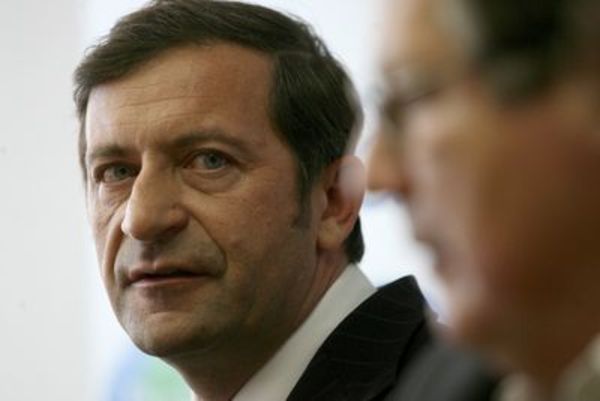
Mayor of Ljubljana Zoran Janković has finally publicly declared his voting preference for Sunday’s elections – he supports the entire Trio From The Left Bloc that is LDS, SD and ZARES.

20080917_zoki.jpg
Video stills from video by Denis Sarkić, vest.si (source)

His decision is actually not surprising at all. Many were hoping that he would support only one party, giving it an extra boost. No such luck. He said that he sees Borut Pahor, Katarina Kresal and Gregor Golobič as equally capable of leading the country and that it is the mix of their political platforms which is what Slovenia needs right now and he asked citizens of Ljubljana no vote for one of three parties and against Janez Janša and the ruling coalition. Which sounds a bit like re-inventing hot water.

It should be noted, however, that there is one notable exception to Janković’s prefferences: DeSUS – the pensioners’ party. Its president Karel Erjavec namely did not promise Zoran Janković that DeSUS will not enter the coalition with Janša, which seems rahter prudent, since they are poised to play the role of kingmaker and could see a lot of political favours thrown their way. But should they opt to support the political left (which- according to their platform – is their natural enviroment) then the profile of the future government would be all but set. But this is not yet the case.

What is interesting, however, is the awe with which the three parties have looked up to Zoran Janković. The parties were almost competing in which will get a more solid support by the mayor of Slovenia’s capital, as if it were up to him who will win and who will lose. Naturally, it is not up to him (thankfuly) but his peculiar political style, which is an explosive mix of arrogance, naivette, shrewdness, self promotion and political ideals (I am fully aware of the contradictions here, thank you very much) seems to resound well with people far beyond Ljubljana borders. He has a can-do mentality and the people seem to like that, despite the fact that he still somewhat of a political rookie. Or – perhaps – precisely because of that.

In related news, however, former President Milan Kučan said publicly that he will support Social Democrats. This is good news for Borut Pahor, since Kučan is still widely respected and reveered all across Slovenia.

Tommorow: what could go wrong on election day

How The Election System Works

enote.jpg
Electoral units (brown lines) and electoral precints (black lines) (source)

So, today is the day when I write my long-dreaded and difficult post on Slovenian election system. 😕

THE BASICS

Slovenian parliament is consisted of 90 deputies (MPs). 88 of those are elected in general elections, whereas Hungarian and Italian minority get one MP each, elected in their special elections. Political parties which compete for the 88 parliamentary seats must win at least 4 percent of the vote to be eligible to enter the parliament.

THE MINORITIES

Members of Hungarian and Italian minorities vote twice. As citizens of the Republic of Slovenia they cast their vote for any of the parties competing for the 88 seats, but as members of a minority, they also cast a vote for minority MP. Only a member of a minortiy can run for a minority seat in the parliament, and he can be elected only by members of his/her minority. There are some 9000 members of Italian minority and some 3000 members of Hungarian minority in Slovenia and their MPs traditionally sided with whatever government there was in power.

THE SYSTEM

Slovenia is divided into eight voting units, each of them divided into eleven voting precincts, equaling 88 precincts, with 11 MPs elected from a particular unit. But – as we shall see – this does not mean that every precinct gets its own MP. Technically, the system in place is called “proportional electoral system with elements of majoritarian system“.

Also, bear in mind that votes for parties which have not received more 4 percent of the vote or more, will not be included in the calculation of the result.

The number of mandates (seats in the parliament) is calculated twice, first using the Drop quota, and then using the d’Hondt method.

DROOP QUOTA

After he votes had been counted by precinct voting committees, all the votes for a particular party are calculated on a per-voting-unit basis and then divided by twelve. We get a number which the total number of votes for a party is divided with. The result (rounded to the lower non-decimal number) is the number of seats for a particular party. Which of the party’s candidates from a the voting unit will make it to the parliament, however, will depend on how many votes they have received in their respective precinct.

Let’s assume that party X got some 60.000 votes in a voting unit which consists of some 200.000 eligible voters. Divide that with 12 and you get 16.666,67. Now divide 60.000 (the number of votes) with 16.667,<67 and you get 3.59 mandates. This means that our party X got 3 mandates, which go to those three candidates from its list which have received the largest number of votes in their respective precints. Apply this method to every other party and repeat for all eight voting units, and you have given away most of the 88 mandates. D’HONDT METHOD

What is left of the 88 mandates is calculated using the d’Hondt method. This was a pain the arse even when I was at the university, so forgive me for being a bit slow in writing this… In this method, the total number of mandates all parties would have received on state level is calculated, by dividing total number of votes by every number from 1 to 88, where the quotient (1 to 88) is increased by one when the result of the operation for the strongest party equals less than the total number of votes for the next strongest party.

Have a good look at this Wikipedia example for a detailed explanation.

Hoever, in case of Slovenia and our party X the d’Hont method is only used to get the number of mandates beyond what the party had already won using the Droop quota. So, if Party X got 15 mandates using the Droop quota and would have goten seventeen mandates using d’Hondt method, it gets two additional mandates, totalling seventen.

PROs and CONs

One of the drawbacks of this system is that not every precinct necesarily gets its own MP. Since candidates of every party are listed according to the number of votes in voting unit it is possible for a precinct to be MP-less if most of its candidates across the board fared miserably compared to their coleagues in other precintcs within the voting unit. Also, the system allows for the mathematical possibility that Candidate A for party X gets more votes in voting unit 1 than candidate B in voting unit 2, but it will be candidate B who gets in the parliament, because he fared better within the unit.

On the other hand, the above anomalies are not all that abundant, whereas the system as such prevents MPs as being solely representatives of their constituents. Rather, each of them is reprepsenting voters as a whole, making it a trifle more difficult for an MP to push a set of particular interests on the agenda.

I hope any of this made sense. My head is still spinning 😀


Tommorow: Whom did Ljubljana Mayor Zoran Janković pick as his favourite?

Parking a Truckload of Sodium in a Swimming Pool

patria.jpg

Slovenian elections are less than eight days away and the field is both wide open and totally closed at the same time. On one hand it is more or less apparent that Janez Janša‘s SDS and Borut Pahor‘s Social Democrats (SD) will take most of the vote, with all the other parties competing for scraps. True, those “scraps” might come in chunks of different sizes, but compared to SDS and SD they will still be just scraps. On the other hand, it is precisely those scraps which might very well decide the immediate political future of this country, so the next couple of days will be a statistic’s paradise.

PATRIA

But before we look at the latest polls, we must take a look at a subject which was rarely mentioned on this blog, mostly because it had – in my opinion – little or no relevance. The Patria APCs arms deal. Long story short, Slovenian Army wanted to buy tank-like eight-wheel-drive APCs and it got to pick between American owned, Austrian made and Slovenian assembled Valuk (by Sistemska Tehnika from Ravne na Koroškem, Slovenia) and Finnish owned, Finnish made and (after much pressure) Slovenian assembled Patria (by Patria Vehicles, Finland). The deal went to Patria, opposition went apeshit, citing national interest, loss of jobs and the usual bullshit and has been doing it for the past year.

However.

At some point Finnish criminal police got interested (apparently via an unrelated case) and soon a lot of communication was going back and forth between Finland, Slovenia, Austria and some other countries. Or not. Because it transpired later that a request for information on suspicion of money laundering was made by Austrian Interpol to its Slovenian counterparts, but the Interpol section of Slovene police somehow managed to forget about the document. Convenient.

Anyways. Some ten days ago, Finnish national broadcaster YLE ran a 30-minute piece The Truth About Patria which dealt with the way Patria does business and the show ended with a statement that in order to close the deal in Slovenia, Patria had to bribe a certain “J” with 20 milion euros. “J” supposedly stood for “Janez Janša”.

OUCH

Obviously shit hit the fan and Patria immediatly overshadowed every other issue of this election campaign. Right wing parties (mostly Janša’s SDS) screamed conspiracy and treason, saying that the whole thing was coordinated by Social Democrats, since the opposition frontman on the issue is Milan Cvikl (formerly of LDS, now of SD) and – watch this – because the head of the Finnish national broadcaster is a member of Finland Social Democratic party. Furthermore, according to , this was an attempt at tainting Slovenian reputation internationaly, which is unpatriotic, tantamount to high treason and leads straight to the 9th circle of hell.

The parliament convened a special session, which – after twelve hours of debate – solved nothing and predictably passed only those resolutions which suited the coalition. And while the right wing parties were fuming with rage, the pensioners’ party (DeSUS) which is also a coalition member and whose president Karel Erjavec as minister of defence signed the actual deal, more or less played stupid, repeating the mantra that Patria made a better offer and that the deal can be canceled if evidence of corruption is found.

POLLS, VICTIMS and EVIDENCE

When Janez Janša declared the war against tycoons, it failed to produce a bump in the polls for SDS. Pengovsky speculated back then that rather that creating a bump, that particular series of moves which included high profile arrests was actually aimed at preventing a dip in the polls, that – in short – rather than gaining votes it prevented losing them. Patria, however, appeared to be a whole different story. After the 30 minute show was re-run on Slovenian state television, Borut Pahor and his SD began losing votes, which was largely attributed to the fact that Janša was perceived as a victim in this case and Slovene electorate traditionally sides with the victim.

In recent history this happened in 2006, only days before municipal elections in Ljubljana, when right wing parties, very much aided by the government of Janez Janša and Laško Brewery (whose CEO Boško Šrot was at the time still good chums with Janez Janša) produced a half-baked document which was meant to implicate Zoran Janković in a number of dodgy deals and presenting him as an overall bad guy. The document’s only effect was to victimise Janković, quite possibly propelling him from a narrow victory to a landslide win of more than 63 percent and generating enough votes for his list of candidates to win an absolute majority, making his life as a mayor indefinitely easier.

Not having learned from its mistakes, the right bloc tried to pull the same trick days before the second round of presidential elections in 2007, when foreign ministry released a document that Danilo Türk was listed as a member of Yugoslav delegation to the UN as late as 1992, although Slovenia declared independence in 1991. When interpreting the document, the right bloc coveniently forgot that Slovenia was not a member of the UN until late May 1992, victimising Türk in the process and quite possibly contributing to yet another landslide victory for the opposition candidate against coalition-backed Lojze Peterle.

The moral of the story being that in order to discredit your political opponent in Slovenia you need rock solid evidence. And in the case of Patria, no evidence is forthcoming. The opposition claims that evidence exists, but so far failed to produce them. Which is odd, to say the least. On the other hand, the prime minister pre-emptively said that if there is any shred of evidence, it is surely faked, which is not exactly what one would call a strong denial. But it was enough for SDS to start gaining votes as it was Janez Janša who was being victimised this time around.

MEDIA

But hey, you can alway count on the current coalition to shoot itself in the foot (on a side note, this is generaly true of the left bloc, but we’ll get there). Just as he was beggining to see his ratings surge, Janez Janša went on an anti-media rampage yet again. He blasted most Slovene media for blowing the Patria story way out of proportion. He called the Finnish 30-minute programme one-sided and demaned that Finnish public broadcaster YLE runs another programme, in which Slovene government would present its side of the story. And when YLE refused, he called his Finnish counterpart Matti Vanhanen and asked him to “put his house in order”, so to speak. Vanhanen replied saying that he will not deal with the media. At all.

Not that it stopped there. The Eternal Foreign Minister Dimitrij Rupel sent two diplomatic notes to Finland, first asking asking the state of Finland to disclose which evidence supposedly implicate Slovenian prime minister since its broadcaster had the balls to implicate him in the first place and second, reiterating its demands, and “reminding” the Finnish government that is owns both its public broadcaster as well as Patria Enterprises and that it should act appropriately. Foreign ministry of Finland more or less replied that in their view the appropriate course of action is to leave the media and the investigators alone to do their business independently and without pressures being brought to bear.

A “haista vittu” if I ever heard one,although the term “Vetäkää käteenne” might be more appropriate in this case 🙂 (with thanks to Disablez, gandalf and Dr. Arf)

L’ETAT, C’EST MOI

And so the focus has now (perhaps temporarily) shifted from producing evidence to Janša and his SDS going nuts and (in the words of a beatuiful Slovenian proverb) destroying with their arses what they built with their hands. But let us not forget that so far no actual evidence is forhtcoming as yet and although one can conclude quite a lot from the fac that Janša’s name somehow made its way in every arms scandal in this country to date, the case is far from closed.

But. Reactions of Janez Janša, Dimitrij Rupel et al. – even if we allow for the fact that they are somewhat exaggerated due to the campaing, clearly show how they perceive the concepts of power, state and ownership. Apparently, the Republic of Slovenia will sue YLE for implicating Janez Janša in the scandal. That is: the state as an istitution will sue a public broadcaster of another state because an individual who happens to hold a temporary job of a PM, was named in a bribery scandal. Apparently in the heads of the SDS the person and his/her office are one and the same – and this goes for any country in the world. If you are a prime minister, you are the country, and if you are the country, you also own everything that is of the country. L’etat, c’est moi.

MEANWHILE IN THEIR BATCAVE…

Things are not quiet on the left front, however… After Borut Pahor froze in the first duel with Janez Janša and positively crashed and burned (amid rivers of sweat) on the second one where all the party leaders were present, the left bloc had a lot of thinking to do. The official story is that Pahor came down with a kidney inflamation, but there are alternative theories as well, one of them linking the state of his kindeys to apparently large quantities of energy drinks he claimed to ingest, quite another that he just fucked up and came way too dressed for the occasion and started cooking under the hot studio lights.

In any case, the left bloc failed to deliever the final push. Pahor had the means but lacked the zest, proving that he is very good in scripted enviroments, but not so good when it comes to improvisations. On the other hand, Gregor Golobič proved very adept in precisely those circumstances, but there is only so much one can do with a base of seven percent of votes in the polls, not to mention the fact that he and his ZARES party still carry a lot of baggage from previous terms, when they were one with Liberal Democrats (LDS). Katarina Kresal, the current president of LDS, however, can be very very effective, but since she just lack mileage in Slovenian politics and has yet to prove herself.

And so it dawned on the left bloc that they may not win the elections afterall. Which sent shivers down their spines, naturally, and they began to explore alternative options once again. One of the alternative options seems to be picking a new name as their candidate for prime minister, and in that respect one name keeps popping up: Mayor of Ljubljana Zoran Janković.

It was initially thought that this particular piece of information was placed in circulation by SDS because they a) wanted to drive a wedge between ZARES and LDS on one side and SD and their ambitions leader on the other, or b) they go rabid at the sight of Zoran Janković, who – as a PM – would probably be their worst nighmare.

However, in the last week, Zoki – when asked about it by yours trully – publicly said that he cannot give an answer to that, because a) no one asked him about it and b) can not in all honesty tell how he would decide if someone asked him to take the job. This was a bombshell, especially because Janković always maintained that he will not run in this elections. However, fair’s fair and The Sherrif of Ljubljana specifically said that he will not run in this election in any way, shape or form. This, however, does not mean that he is not willing to take on the premiership some time after the elections.

THE KINGMAKER

Exactly who will be greeting pengovsky at this year’s prime minister’s reception for the media will – it seems – depend in large part on Karel Erjavec of DeSUS (Democratic party of Pensioners), which is largely expected to perform rather well Sunday next. Some pollsters even expect them to take third place, beating ZARES and LDS. Even if that does not happen, the distribution of votes will most likely make it impossible either for Janša or Pahor to form a coalition without DeSUS, thus putting Karel Erjavec in the role of a kingmaker and probably winning him the office of defence minister yet again (if you’re interested why a president of a pensioners’ party wants to run defence and not – say – social affair: Erjavec went on the record saying that he’d prefer one of the easier jobs in the government).

HOW DOES IT ALL PLAY OUT

Due to provisions of elections legislation, today is the final day when public opinion polls can be published (meaning that I’ll take down the election badge as well) and the general consensus is that Janša’s SDS will be the relative winner in a week’s time, beating Borut Pahor’s Social Democrats by a couple of percentage points (one poll, however, predicts a 10-percent gap). A lot will depend on the turnout, which is predicted around 60 percent and which is the Achile’s heel of the left bloc. Namely, its voters are notoriously udisciplined and it takes a huge nudge to get the vote out, whereas voters of the right bloc are much more disciplined. Naturally, this is on average. Pengovsky, for example will vote every time, even if they called a referedum on the height of grass on the new Ljubljana Stadium.

Anyhoo. The mandate for forming of the government will probably go to the relative winner. As of late there are some ideas that if the left is capable of forming the government, then president Türk should give the mandate directly to Borut Pahor, skipping Janez Janša, but pengovsky thinks that would be an out-and-out bad idea. Apparently would-be PM Pahor shares the sentiment.

POSSIBLE COALITIONS

So, provided that SDS wins the elections by a small margin, there are number of possible combinations, including the possibility that a member of the left bloc breaks ranks and goes to bed with Janez Janša. To be brutally honest, any member of the trio SD-ZARES-LDS is very much capable of doing that, especially if one takes into account the results that same move had for DeSUS four years ago (it went from insignificant to kingmaker-apparent). But making such a move would have massive reprecussion for the leadership of the party that did it. Borut Pahor (SD) would probably we taken out of his office legs first, because the party really expected to win and he will be facing a lot of disenchanted members as it were. Shacking up with their political arch-enemy will not make them happy. Gregor Golobič is pragmatic enough to entertain such thoughts, but his problems lie in the fact that if he teamed up with Janez Janša, he would probably alienate powerful supporters of the left bloc, most notably Zoran Janković and possibly Milan Kučan – not to mention his very fervent base. It’s not as if Golobič is taking orders from anyone, but the cost/benefit analysis would most likely show that forming a coalition with Janša would not be a good idea. Leaving only Katarina Kresal and LDS. Throughout the campaign she was most artedntly opposed to making such a move so going to bed with JJ would cost her whatever credibility she managed to acquire within a year since she entered top-level politics.

So, provided that none of the trio join Janša in ruling the country, it becomes clear that if Janša wins, he will have to repeat the current coalition and add Zmago Jelinčič‘s nationalists to the roster. Polls predict that NSi of finance minister Andrej Bajuk might not even make it past the 4% threshold (pengovsky still thinks they’ll make it, though), but whatever the constellation of this particular scenario, it is clear that DeSUS would be the second largest coalition partner, making it infinitely more powerful than it is today (which, by the way is terrible news for Slovenian politics as such. How can a cleveage party get so much influence!?)

This would be a very troubled coalition from the start. Even when he was the most junior coalition partner, DeSUS did not really to the line and Karel Erjavec frequently left PM Janša out in the cold, knowing that Janša needs his votes. Add Zmago Jelinčič’s nationalists to the equation and you have a political zoo on your hands. Jelinčič and his bunch of unrully would-be lone rangers are the most erractic force (forcette, rahter) in Slovenian political field. SNS started out as a proper skin-head, blood-and-honour, Ausländer-raus, white-supremacist party, but less than ten years later Jelinčič ran on an anti-NATO, pro-Serb platform, as elections were held during NATO’s Kosovo campaign. He also had a pro-partisan and anti-Croatian agendas and got into the parliament every time sine 1992. Having him as a coalition member is like parking a truckload of sodium in a swimming pool. They are bound to react violently.

So if Janez Janša wins the second term, his government will be very weak and given the not-so-brigh economic future we are facing, combined with unpredictable coalition members and the opposition for once doing its job, this particular government is very likely to collapse by 2010.

By which time Zoran Janković will have finished his term as Mayor of Ljubljana.

Catch my drift?


Next week: What could go wrong on election day, who will get the nod of approval by Zoran Janković how the voting system works and many other goodies.

The Force Will Be With Him. Always.

Pengovsky is still clearing his backlog, so a serious new post will have to wait a day or two more. However, you should know that shit in Slovenia hit the fan with the prime minister being accused of taking a huge bribe in and arms deal (suprise, surprise) with Finland-based Patria Vehicles. To cut a long story short, Slovenia is buying a number Finnish APCs and not everbody is happy. Defence minister Karel Erjavec has so far shown many teflon-like qualities, deflecting shit thrown at him by playing dumb, ignorant or sarcastic (or any combination of the three).

The story of Slovene PM Janša being bribed, however, was broken by a programme on Finnish state television. Janša and indeed most of the top levels of government went apeshit, forgot that Finland is not Slovenia and demanded that Finnish state TV run another programe, detailing the Slovene government’s version of events. The Finns obviously told my government to go fuck itself (perhaps not in such a colourful langugage, but hey – I don’t speak Finnish :)) and stood by its programe.

So instead Janša went to the competition in Finland. Tonight, Nelonen TV runs an interview with Janez Janša. It is all very sombre, right until the very end where something strange happens.


Video recoded by Vest.si. Original on Nelonen TV.

And then one starts to wonder what kind of an interview this was. Aha! A clue, Sherlock!.

But this is just to keep you amused while I get back on track. In the mean time someone get the man his breathing mask and a light sabre… :mrgreen:

Get The Fuck Off The Stage

This one is exactly a week old, but it is still a telling story. Upon his return to his hometown of Brežice, Slovenian Olympic gold-medalist Primož Kozmus was greeted by more that 5000 fans and a couple of politicians, including Prime Minster Janez Janša, who was – somewhat surprisingly – booed throughout his short speech. Surprsingly, because booing at politicians is not exactly commonplace in Slovenia. Indeed I’d venture to say that even Milan Kučan at an SDS even would receive a warmer reception (OK, I may be pushing it here :)) And secondly, because Janša’s SDS carried Brežice by a huge margin in 2004 elections (it got some 44% of the vote) and yet Janša was received by a definite lack of enthusiasm.


Janša starts talking at 02:00 (source: POP TV)

Now it could very well be argued that it wasn’t political and that the crowd just resented JJ trying to steal the moment and thougth that he had no place on the stage, but only weeks before elections everything is political. And the PM getting booed at is not a good thing. But he needn’t worry. RTVSLO – the state television did not report on it at all. Instead, they cut his speech out altogether, and just showed his handing back the microfone with the crowd cheering. It looked much better 😈

EDIT: You’ve got a nice comparison over at JaKa’s – he dug out SDS‘s version of the event and the one published by Vest.si

A Turning Point In Election Campaign?

Apparently it wasn’t just pengovsky who wasn’t all that impressed by Borut Pahor’s perfomance Wednesday last. Dnevnik ran a poll on Saturday where Janša’s SDS for the first time in more than six months enjoys a small-but-distinctive lead over opposition Social Democrats. 1.9 percent might not seem a lot – and is still very much within the margin or error – but in terms of a dead heat between SDS and SD we’ve been seeing for the past few weeks, this is quite an important shift. Namely, Pahor’s SD got 17.4 percent, while Janša’s SDS got 19.3 percent.

20080826_ankica01.jpg

This could very well be a turning point in this election campaign. On one hand Borut Pahor and his SD have more than enough time to rectify things, on the other hand, however, they don’t have enough time to wait for another poll and act then. One more result like this and the glow of victory surrounding Pahor at the moment will have diminished dangerously (dangeroulsy for his prime-ministerial ambitions, that is). The same thing happened in presidential elections a year ago, when Lojze Peterle was long thought of as having already cliched a victory, but as he didn’t win in the first round, he had to reposition himself, but by then he was no longer thought of as invincible and unbeatable (with a little help of Janez Janša becoming as unpopular as he was ever going to get). Today, with 26 days until elections this is the worst possible time for Pahor to have to make a come-back in polls. Because if he looses the aura of PM-apparent, he is facing an extremely uphill battle. Luckily for him, the three parties of the left bloc (SD, Zares and LDS) still enjoy a comfortable lead over the three right wing parties (SDS, NSi and SLS).

20080826_ankica03.jpg

Pengovsky’s projection:: This could very well be it. If Pahor and SD don’t do anything about it (or go about it the wrong way) it can all go downhill from here. It is highly likely that Borut Pahor will adopt a more hard line rhetoric, but if he overdoes it, it will backfire, alienating moderate voters. Also, as he did a rather poor job at citing numbers, Pahor will probably do a crash-course in economy or (sligthy more likely but less effective) will stand firmly alongside Mitja Gaspari as the latter will try to tear the economic policies of this government to pieces. Pengovsky eagerly awaits next polls.

Election 2008 badge: Will be updated during the day.

Data: Is avilable in MS Excel file.

We’ll Have To Check That

Yesterday’s opening debate between PM Janez Janša and leader of the opposition Social Democrats Borut Pahor was a suprisingly one-sided event. Borut Pahor failed to challenge Janez Janša even once and although the former did attempt to throw around a couple of figures, he never stuck to them, but mostly answered Janša’s rebuttals with “well, we will have to check that”.

20080821_pahor_jansa.jpg
Borut Pahor and Janez Janša during yesterday’s debate (source: RTV SLO)

Now, fair’s fair and it has to be said that Janša didn’t do a brilliant job either. He was, however, much more effective in bringing his point accross, mostly in terms of trying to make a connection between Boško Šrot (of Laško Brewery) and Borut Pahor. Here the leader of SD was on a constant defensive and was looking for a quick way out. On the other hand, when the debate turned to the Janša – Sanader affair, Pahor insinuated to be in posession of certain information but supposely remained quiet for the better good. Which might be very noble of him, if it weren’t for the official conclusion of the parliamentary committee, which says that Janša indeed communicated with Croatian PM Ivo Sanader just prior to 2004 elections (and subsequent Janša’s victory), but that the two did not arrange for borded incidents.

IT’S THE ECONOMY, STUPID!

Even on a more “mundane” level Pahor failed to make a lasting impression. Common sense dictates that economy should be at the forefront of the debate, with a high inflation and a slowdown in economy. And while Pahor made a couple of good points, he again failed to substantiate them with refferences to specifics. He correctly pointed out that most of last year’s more-than-solid GDP growth was created in the construction sector, which mostly employes immigrants who obviously did not spend their money in Slovenia, but when Janša replied that most of the growth was created by SMEs (which is an outright lie), Pahor failed to press him on that. Similarly on the debate on health sector, where Pahor first said that there is less money available, but when Janša said that it wasn’t true, Pahor said that he would love to show graphs but that there was no time. And when the moderator asked Pahor what should be done to alieviate the economic troubles ahead, Pahor replied by pointing out what was not done, without proposing a set of policies for the future. I realize Janša did much of the same, but it is up to Pahor to propose alternatives and his lacking to do so in this case stuck out like a sore thumb

FOREIGN RELATIONS

One would think that international relations would be one of the fields where Pahor would excel. He was, afterall, a serious contender for the post of Foreign Minsiter on several occasions, he does have the knowledge, the diplomatic attitude and clothes to match. He also majored in international relations (his thesis dealt with international terrorism, and that was more than twenty years ago) and is an MEP at the moment. And yet Janša was not taken by surprise when both were asked whether and if, how, would they Croatian EU aspirations to solve Slovene-Croat border disputes. Pahor gave a very honest (and in my oppinion very good) answer, saying that he would do no such thing, adding that Slovenia has many other leverages within EU and that it should not use Brussels to solve a bilateral problem. Janša on the other hand eluded a direct answer, saying that Croatia has similar problems with Bosnia, Serbia and Montenegro. And agian, Pahor missed an opportunity to point out failures of PM Janša and his Foreign Minister Dimitrij Rupel which are not all that few-and-far-between.

MEDIA, MYSELF & I

There was one field where Pahor had Janša pinned to the wall, so to speak. He was very persistent in pointing out that he would be far better a prime minister than Janša was. Which isn’t saying much, mind you. But even so, it would be nice to point out how exactly would Borut Pahor be a better PM. Again, he tried to to that, but with limited success. I’ll give Pahor credit for sticking to his mantra of not commenting the media at all (as opposed to Janša’s urge to control them), but here Janša coutnered that they were not all that different, Pahor and he. To which Pahor failed to mention Delo takeover, control of state television, Janša’s one-on-ones with pro-government journalists, two free-of-charge rags, disguised as newspapers, supposedly written by journalists which are most likely SDS party faithfuls who have never written an article in their lives, the statement by FM Dimitrij Rupel that “countering the goverment will cost dearly any media which would dare do so”, et cetera, et cetera. But still, Pahor said that he would be a much better PM.

And for finale, they both embarked on a poor-me-journey, sobbing about how much each of them hurt when a) Janša was portrayed by members of Social Democrats as a traitor for his confabulation with Croatian PM Sanader and b) Pahor was portrayed by Janša as a media control-freak because Boško Šrot was a member od SD. This particular part was – this must be said – difficult to watch, because there they were, two middle-aged men both trying to persuade the people that they are the right choice for the top job and…. they get misty-eyed??? I almost went Boys, get a room!

So. Janša won this opening match fair and square. Pahor’s attacks were feeble, defence practically non-existant. There were a couple of solo-attempts, but they ammounted to surprisingly little. However, this match was palyed on Janša’s home turf (state television). It will be interesting to see how they both fare on POP TV. If Janša agrees for a duel, that is. Rumours have it that he is looking for a way out of it, not in the least because the moderartors there will most likely resemble a pack of rabid pit-bulls and give Janša and everyone else precious little room to breathe. But – in Pahor’s words – we’ll have to check that.