Vlado Miheljak Apologises For Janez Janša

That’s right. The columnist whom Janez Janša threatned to sue issued an appology in his regular column in today’s Dnevnik daily. But he didn’t apologise to Janez Janša, he apologised for him.

20090114_miheljak.jpg
Vlado Miheljak and cartoon in his today column (by Franco Juri) (source and source)

In a nutshell. Miheljak of course never had any intention to apologise to Janša. Instead, as predicted by yours trully, he drew parallels between Janša being imprisoned in 1988 on the grounds of publishing things harmful to the government (which was a criminal offence back then) and Janša filing suits against people which publish things harmful to Janša’s government. In the last few days the former PM stated on many occasions that he feels compeled to defend the legacy of his government. Apparently, he also feels that this can be effectively achieved by dragging anyone who doesn’t agree with him to court.

Truth be told, Vlado Miheljak is not the easiest of characters out there. He is known for raining on parade of any political option which feels too pleased with itself. This especially includes the political left, even though Miheljak’s political sympathies lay firmly in the left side of the spectrum. He is known for deconstructing almost anyone and anything that comes in his crosshairs, although – this must be said – his edge blumted considerably after twenty years of cutting through stupidites of petty politicking this country seems to be perpetually infested with.

However, his relationship with Janez Janša is something special. After Janez Janša was arrested for supposedly publishing top secret information in an article published by Mladina weekly in 1988, Miheljak was one of the more prominent members of the Committee for Protection of Human Rights which worked for the release of Janša and fellow prisoners in 1988. All of this is generally known.

A little less generally know is the fact that the text which got Janša arrested in 1988 was actually written by Miheljak.

And today it seems, Janša is doing what the Jugoslav Army probably wanted to do twenty years ago. And alhtough he received a lot of support from a lot of people in the last few days, I’m pretty certain that while supporting Miheljak they privatly muse thinking that it “serves the bastard right”. But the outcome of this battle is already known. In a fight with Vlado Miheljak the other side always loses.

Trust Is Good. Control Is Better. Lawsuits Are The Best.

When the most good looking of European leaders (and I’m not talking about Silvio Berlusoni) is not busy reassuring the fair people of Slovenia that his government has things under control, he is apparently indluging in massive politically motivated changes at the helm of various state companies. Janez Janša‘s SDS even published a counter on its website, displaying the number of politically motivated changes – according to their count. At the time od this writing, the number has reached a staggering twenty-eight.

stevec.jpg
Replacements counter on www.sds.si

There are some 3700 senior staff in the civil service and para-government institutions. So far, the government of Borut Pahor replaced twenty eight people, which means that the SDS views every replacemement as political. But why is this such a problem? Because Borut Pahor promised in the election campaign that his government will only replace people if they prove to be incompetent. Which he even may have planned to do, but as one administration sets in certain personel changes are inevitable. I mean, it is sort of natural that a new minister will want someone he can trust and knows he/she can work with as, say, secretary general of the ministry (basically the head of the administration). Also, if the new government wants to pursue a different set of policies with regard to the companies the state owns, it seems logical that state’s representatives in those companies are replaced.

However. Replacements as such are not a problem. The problem is whom does the government replace these people with. If competence really is the main criteria(as opposed to Janša’s regime where party membership was the prevalent factor), then it must be said that this criteria could be enforced much more thoroughly than it is at the moment. Case in point being the recent nomination of Draško Veselinovič as the CEO of Nova Ljubljanska banka (NLB), the largest Slovene bank.

Veselinovič was basically a shoo-in as he was nominated and confirmed by the bank’s supervisory board and not in a shareholders’ meeting. Although he does come from the world of finance (until now he was CEO of Deželna banka, a small rural-oriented bank, before that the CEO of Ljubljana stock exchange), he also ran on LDS ticket in last year’s parliamentary elections and nearly got elected. In fact, he came so close that once party president Katarina Kresal became Minister of the Interior, he was next in line to become an MP. Instead, he took a pass, allowing long-time MP Tone Anderlič to get into the parliament yet again, while he himself waited for what must surely have been a job offer agreed in advance. At least in general terms.

And even that might be acceptable (might being the operative word). But in my book Veselinovič’s main problem is the fact that he was embroiled in a scandal on Ljubljana stock exchange when a number of high profile stock-brokers and heads of stock-brokerin firms lost their licences, while Veselinovič and the other member of a two-man Board had to resign their posts due to allegations that firms increased their values at the end of the year by closing virtual deals on the stock exchange. Although the case against Veselinovič was dropped (due to lack of evidence) this is not exactly a thing you want on a resume of a CEO of the nation’s largest bank. But hey, Borut Pahor probably agreed on Veselinovič as a reward to LDS for playing ball and not causing too much trouble during formation of the government. Thus everyone is happy.

Everyone? Not exactly. Zares, the second largest coalition partner is fuming. Specifically, its president Gregor Golobič and minister of economy Matej Lahovnik went apeshit over Veselinovič and when PM Pahor pulled the same stunt only days later in forming an Energy Council (a supposedly advisory body on energy policies), Lahovnik basically threatened to resign (Lahovnik: “if this goes on each of us will have to rethink its role in this government”). As the energy sector is under the jurisdiction of Ministry of Economy, Lahovnik was somewhat suprised that this council was formed unbeknownst to him, prompting his party boss Gregor Golobič to demand a coalition summit where a detailed procedure for future nominations would be agreed upon.

Trust is good, control is better, said Lenin.

DeSUS, it seems, is keeping quiet.

However, former PM Janez Janša is not keeping quiet. Apparently he is about to file yet another suit, this time against columnist Vlado Miheljak who has been indulging in deconstructing Janša’s personality for the last 20 years (Miheljak is a clinical psychiatrist by education and a professor of psychology by trade) and apparently Janša had had it last Wednesday, when Miheljak in his column for Dnevnik daily wrote that Janša more or less wrecked Slovenia.

Vlado Miheljak has now joined the distinguished club of Tone Rop, Boško Šrot, Magnus Berglund, Drago Kos, Bojan Potočnik and fellow psychiatrist Slavko Ziherl. I suspect that in tomorrow’s column Miheljak will draw paradoxes from Janša being wrongly accused by the Army in 1988 and Janša wrongly accusing others of slander in 2009.

Should be fun.

This brings the total number of people Janša is sueing to seven. Ha! It took an entire government to replace 28 people, while Janša in more or less same period of time personally dragged seven people to court. No wonder his government was able to replace hundreds.

The Parliament Kitchen

One of the perks of being a Slovenian MP is also having access to what is popularely known as the “parliament kitchen”. Today a canteen, it was a full-blown restaurant until a couple of years ago, but still retains some of the best cooks and a very experienced chef.

20090108_hrana.jpg
The food in the parliament kitchen (source)

But apart from being good (and I mean really good), the food in there is dirt cheap. And it is precisely that fact which periodically draws cries of outrage by journalists, blogers, Facebook users and other fine people of this country. I mean, they do have a point. Three-course menu for 4 euros? Coffe and a sandwich for 1.20 eiuros (approx.)?

Compare that with some 12+ euros for a two-course quickie in a nearby diner, or 2.20 euros for an espresso and croissant pengovsky pays almost every morning in one of his watering holes and you start thinking someone is charging dumping prices. The usual argument goes along the lines of MPs earning some 3000+ euros monthly for just sitting there and pressing buttons, so why the fuck shouldn’t they pay proper prices for their food? In the eyes of many this is just another example of MPs making their life comfortable whitout giving a pair of dingo’s kindeys about anyone else.

While popular, the reasoning is both wrong and demagogical. Namely, the “parliament kitchen” is not suppose to make profit. It is not a company but a service the institution provides to the people working there. Also, the staff are on the parliament’s payroll and are not employed by the kitchen itself. In short, their salaries are financed by the budget and not by income the kitchen makes. Therefore it is only correct, that meal prices in there are lower, as they only need to cover the actual cost of production, and do not include labour cost nor a profit margin.

In fact… If the prices in the parliament kitchen represent the basic cost of meal production, it is entirely reasonable to ask how big a profit margin bars and restaurants really charge. Take coffee, for example, since prices of a single cup of coffee very wildly in Ljubljana. Naturally, in “normal” bars and restaurants prices include the cost of labour as well. The hourly wage is around four euros, and the lowest price of an espresso is around one euro. Knowing that the production cost of a cup of espresso in the parliament kitchen in half a euro, we can roughly calculate that a waiter has to serve eight espressos every hour to make his or her hourly wage. Anything beyond that goes to the owner. And that’s only selling espressos. If you consider food (normal price 12 euros), the profit margin is even greater, as a watier would have to sell one menu every two hours to make his wage. Anything beyond that again goes to the owner.

So – it’s not that the parliament kitchen is dirt chip. Rather it is the fact that bars and restaurants are charging attrocious prices for product and service that often leave a lot to be desired. And one more thing – contrary to popular belief, the parliament kitchen does not serve only ninety elected representatives of the people. It also feeds almost four hundred parliament employees and most of them don’t make 3000 euros per month. Besides, most MPs don’t eat in there. Not classy enough. They rather go to the nearby Maxim, where their wallets will endure a proper degree of abuse.

The Straw That Broke The Camel’s Back

Today a bit more on the Slovene-Croat diplomatic crash which happened shortly before new year, when Slovenia effectively blocked the continuation of Croatian EU accession negotiations.

20090107_slocro.jpg
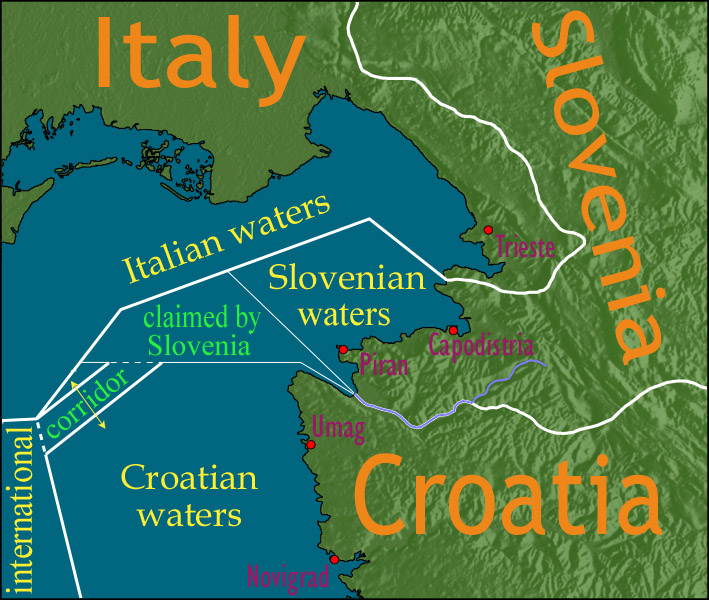
The SLO-CRO border solution as proposed in Drnovšek-Račan Agreement (middle of the Bay of Piran shown as well). Adapted from (source)

As you know, the border dispute between the two countries is as old as the countries themselves. While Yugoslavia was still a country (and not a semi-mythological term of the good old days), it had well defined and furiously defended borders with all its neighbours. Hungary, Romania, Bulgaria, Greece, Albania, Italy and Austria. As the federal country broke appart, most of the emerging new states inherited the defined international borders (Bosnia-Herzegovina being the obvious exception as it bordered only on republics). They did not however inherit well defined internal borders, as these were often only superficially defined to serve administrative purposes. I mean, who cared if the River Mura changed its flow thirty metres to the north?

I remember when I was still a kid, we’d go on summer vacations and some point mid-way my father would say that “we’re in Croatia now”, but there was no sign, no flag, nothing. Just a road juncture. Even more to the point, parhises of Roman Catholic church did not follow the borders between republics, which caused a lot of bad blood some ten-plus years ago, when the tiny parish of Razkrižje was “claimed” by Zagreb Archdiocese. Well at least that particular dispute was quickly solved as the Vatican redrew borders to match the reality on the ground.

And it was exactly the reality on the ground which in the end proved to be the straw which broke the camel’s back. Be it out of political necesity of a country ravaged by war or out of sheer cold calculation, Croatia sought to execute its sovereignity at what it saw as its territory in relation to Slovenia (some would say that it overcompensated for the fact that it could not do so in a significant part of the rest of its territory). This included a part of territory which Slovenia claimed as its own, but – contrary to Croatia – always maintaned that the territory was disputed rather than Slovenian.

Always? Not exactly. It takes two to tango and in this case Slovenia is not without blame. Specifically, the Slovenian parliament at some point early in the game passed a binding resolution, laying claim to entire Bay of Piran, instantly creating a curious negotiation position where Slovenia in effect demanded that a tourist on the Croatian side of the bay would sunbathe in Croatia, but would enter Slovenia when jumping in the sea for a swim.

While the stupidity and naivete of such a resolution can in part be attributed inexperience of a fledling country and its decision-makers, it should be noted that the main proponents of this resolution (even after the imbecility of the text was realised) was the Slovene People’s Party (SLS), whose former presidents, brothers Janez and Marjan Podobnik are known for creating border incidents when it suits them politically
.

Yes, the Bay of Piran. An unsignificant pond of water in its own right is vital for Slovenian access to international waters. Specifically, the way the borded is drawn makes all the difference between Slovenia being a maritime and a nearly landlocked country without direct access to international waters. If the border is drawn midway across the bay, Slovenia can go suck a lemon with its excuse for a sea. Even worse, its strategic Port of Koper would probably be turned into a third-class marine because it would no longer have access to international waters.

The problem is, as noted here, that the maritime border was never drawn (as opposed to borders between republics, which were drawn, but never enforced), leaving the problem with little to no actual precedent to draw from. So both Slovenia and Croatia dug in, each proving to the other why the border should be drawn exactly one way and not the other.

In any case, Croatia imposed its sovereignity on the disputed area and was always seen as playing the table against Slovenia, its poorly and unconflicting neighbour whose foreign policy was in complete disarray. At least, that was the prevailing view in Slovenia. You won’t be surprised that in Croatia Slovenian foreign policy was seen as masterful, with Croatia continually receiving the wrong end of the stick. But in recent years, as Croatian aspirations for EU memberships began to take shape, the country’s pre-modern concept of sovereignity, which is defended at the borders and in full, clashed with European modern concept of sovereignity, where the latter is exerted in relation to other countries via a set of (more or less) predefined rules and – barring that – tends to avoid escalation.

Thus in the beggining of 2008 Croatia basically had to revoke its Ecological Maritime Zone, because it clashed with EU fisheries policies – among other things. The zone also extended all the way to the middle of the Bay of Piran and was yet another attempt to create a new reality on the ground, as it would be imposed by Croatian Navy. And then, at the end of 2008, when Croatia was due to open additional chapters in the negotiation process, Slovenia blocked the move as Croatia in its documents cited its legislation which put the maritime border in the middle of the bay of Piran.

Slovenian move was in stark oppositon with its attitude to date, but it was probably the last chance to defend its maritime interests as all previous attempts to solve the problem have failed. The closest the two countries ever came to an agreement was the so called agreement Drnovšek-Račan, where PMs of both countries, Ivica Račan and Janez Drnovšek agreed on an unconventional solution (the picture above), where Croatia would declare a corridor of its sea as international waters, while keeping a maritime border with Italy, thus giving Slovenia control over most (but not all) of Bay of Piran as well as access to international waters. The agreement met its premature demise in the Croatian parliament, but is now reffered to by Slovenia as a significant point in settling the dispute.

So, what to do? Apparently Slovenia is playing the table against Croatia – this time for real. While it may be the sole voice of opposition to Croatia continuing the accession process, rumours have it that there are other member states which think Croatia should be slowed in its tracks, albeit for differend reasons – mostly to do with corruption and the rule of law in the country. Or the lack thereof, rather. The dispute took EU mostly by surprise, as shown in the now-famous exclamation of French foreign minister Bernard Couchner: “But it’s only 25 kilometres of disputed border!“.

That may be, but small disputes can turn into big problems, especially in the Balkans. And fact of the matter is that Slovenia apparently opted to play hardball, which will probably come in handy in times of economic crisis, keeping people’s mind off more important things. That goes for Croatia as well, mind you, which is apparently nearing an economic collapse not unlike the one in Iceland, because of its overpriced currency, the kuna.

In any case, a compromise will have to be reached. And a compromise during EU negotiation process will hold indefinitely more weight in front of any international border tribunal than any other unilateral move by either party. So they might as well go for broke and settle this thing once and for all. There are two dangers, though. One, that Slovenia, with its new-found confidence will try to compensate for years of being pushed around and will get to brash and will start making humiliating demands. And two, that Croatia, used to getting its way, will continue to over-react as it is completely unused to Slovenia being tough about anything, effectively putting off its EU membership for years or even decades. Imagine the indignation of Serbia making it to the EU before Croatia.

“Lik i djelo” of Comrade Janša

Pengovsky is (yet again) extremely late for today’s posting feast, but it seems that it was worth it. I was about to deliver the skinny on Slovene-Croat storm in a teacup, but something much better emerged today.

20090106_wanted.jpg

It seems that former PM Janez Janša has added one more notch to his lawsuit-happy belt. This time around, Janša filed a lawsuit against Slavko Ziherl, former State Secretary at Minstry of Health who resigned even before he started his job, officially out of protest against PM Borut Pahor‘s naming former FM Dimitrij Rupel as a personal advisor. This is the fifth lawsuit Janša filed in a little less than a year and a half. After filing a lawsuit against his predecessor Tone Rop for accusing him of coordinating border incidents with Croatia, then suing Boško Šrot for claiming that Janša sold Mercator to Šrot as a price for gaining political influence over Delo daily, later in the year he filed a suit against Finnish public broadcaster YLE and its journalist Magnus Berglund for claiming that he (Janša) was bribed in the Patria Affair, and – by the same extention – he also sued the head of the Anti-Corruption Commission Drago Kos and President Turk’s national security advisor Bojan Potočnik, both of whom -according to Janša- implied that he was on the take in the Patria case.

So how come Slavko Ziherl, a member of LDS, whose resignation was prompted by PM Pahor’s inexplicable love for Dimitrij Rupel found himself in Janša’s crosshairs? Well, among many harsh words directed at Pahor in his letter of resignation Ziherl said that he entered politics as late as 2005, prompted by “Janša’s style of governing which posed a danger to many liberal or even human values”. Which was enough for Janša to put him on the “to do” list.

So, what are we looking at here? A lawsuit-happy politico who can’t get enough of himself in the news? I don’t think so. On one hand this is a clear manifestation of one of Janša’s predominant personal traits, and on the other an obsession with defending his public image and record by any means possible.

In former Yugoslavia top politicians were exempt from public scrutiny by having their public image (“lik i djelo) and record legaly protected. At the very least this went for Comrade Tito, and then this implicitly applied to entire top political echelon. Since one of the upsides of a democracy is elimination of such legal nonsense, Janez Janša cannot have (as much as he would have perhaps liked) his “lik i djelo” protected by default. So, he is left to his own devices in protecting it. For most politicians poblic opinion polls and elelctions are enough. Janša, it seems, wants a court to tell him what everyone else already knows…