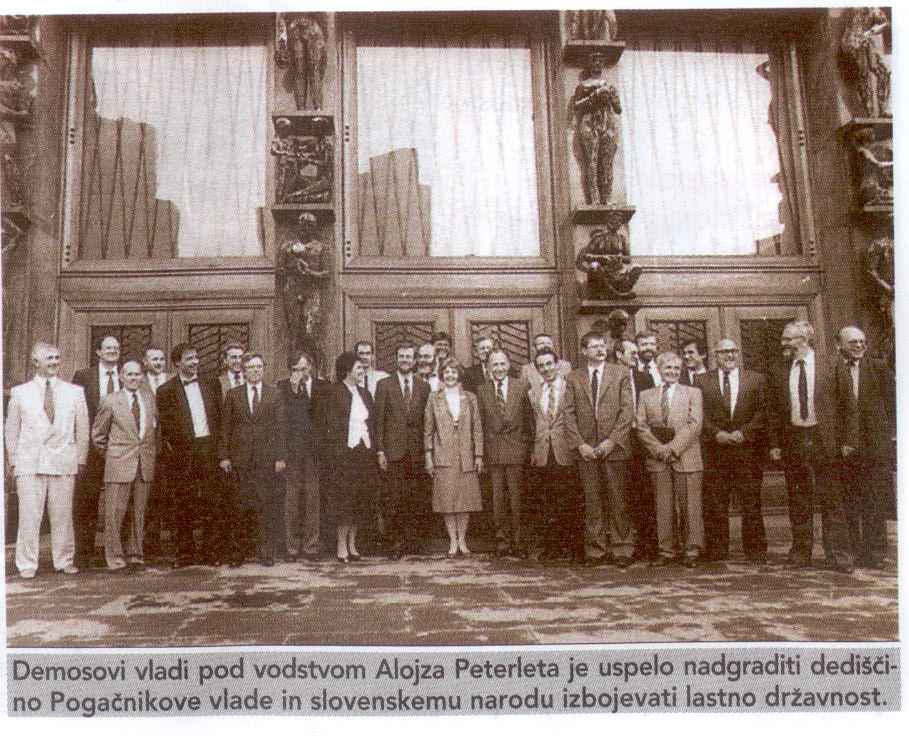
The first Slovene government had 27 ministers. Today there are fourteen. (source)
On Sunday, April 8th Slovenia “celebrated” 17th anniversary of the first democratic elections in it’s modern history. Thankfully there was no real celebration – but you can put that down to the fact that most people celebrated Easter anyhow.
The elections were “general” – meaning that voters chose both the members of the Parliament as well as members of the Presidency. At the time Slovenia had a radically different political system in place. The Parliament (officially: The Assembly of the Republic of Slovenia) was a three chamber body which consisted of the Chamber of Municipalities, Chamber of Work(ers) and Societal-Political Chamber (the translation is a bit awkward, I know). The latter was deemed the most important, although the three chambers were equal in power.
There were numerous parties running in the elections, some were trully exoctic, such as Party of Beer Lovers, Society of Mushroom Pickers and even a gay club. As everyone expected, the oppositon DEMOS coalition won, but it got only 54 percent of the vote in stark contrast with other countries where socialism collapsed and where the opposition basically wiped out the rulling Communist party. Even more – on a party by party count, the League of Communists got the most votes. Surprises did not stop there, though.
An agreement was reached within DEMOS, the party wchih got the most votes within the coalition would name the Prime Minister and everyone thought the victory of Slovene Democratic Union was a foregone conclusion. Everyone but the voters, that its, who gave the most votes within the DEMOS coalition to Christian-Democratic Party, thus making a little known geographer Lojze Peterle the president of the first Slovene democraticly elected government (which at the time went by the name of Executive Council)
At the time Slovenia had a collective presidency, which consisted of the President and of four members, each of whom was equally empowered to run the presidency in case of President’s absence. The main contenders for the President of the Presidency were Milan Kučan, who had just resigned as the President of the League of Communists and the late Jože Pučnik, the leader of DEMOS.
Kučan won after the second round of elections, delivering a major overall blow to the opposition, which based it’s campaign mostly on anti-communism.
Thus the political field was divided between left- and right-wing options. It is generally agreed that the voters (knowingly or otherwise) balanced the field by giving actual power to the right-wing opposition, but accepting the positive role of the League of Communists, which had brought about changes in the constitution just a year before, enabling a relatively smooth transition from a single-party to a multi-party system, and – most of all – the voters recognized the fact that the “old structures” were willing to relinquish the power, thus being radically different from the likes of Ceausescu
In 1990 the Organisation of Socialist Youth, which was the main force of change within the socialist system, got a handsome amount of votes. This party was then renamed to Liberal Democrats and went on to become Slovenia’s most powerful party for more than a decade, from 1992 to 2004.
The Assembly, the Executive Council and the Presidency were primarily charged with holding a referendum on independece, declaring and sustaining the independence (an armed conflict was always considered a likely option), securing international recognition and passing a new constitiution, which established a proper parlimamentary democracy.
In retrospect, the mandate was fulfilled on all counts. The fact that it was all achieved in little more than two years is frankly astonishing, but at the time noone had the time to stop and think about it, because events were literally overtaking one another. This famous chapter of Slovene history started unfolding after DEMOS dissolved due to internal bickering (as their primary goal – independence – was achieved), Lojze Peterle was replaced by Janez Drnovšek as PM, a new Constitution was passed and another general elections were held, this time to the office of The President of the Republic, and to the National Assembly and the National Council. I covered the relations between the three in more detail here.
From today’s perspective, those were the glory days, when men were real men, women were real women, history was in abundance and the air had a smell of good, glorious and important things. In short: Slovenia’s democratic defloration ended with a multiple orgasm. Was that really as good as it gets?